Organic forms in the living room: introducing soft lines without weighing down the space
How to introduce organic forms into the living room by balancing curves, proportions, materials and functionality without weighing down the space.
Organic forms are more than an aesthetic choice
Curves, rounded profiles and soft volumes have become an established part of the contemporary living-room vocabulary. Their popularity is not merely the result of a formal trend: it also reflects the desire for more welcoming, fluid and less rigid interiors, capable of supporting movement and creating a more relaxed domestic atmosphere.
Introducing organic forms, however, does not mean filling the room with curved objects. When the language is repeated without hierarchy, the space can lose structure and appear visually uncertain. The aim is not to eliminate straight geometry, but to create a balance between soft lines and more clearly defined references.
A well-positioned curve can guide the eye, ease circulation, soften the presence of a substantial volume or make a conversation area feel more intimate. It should therefore be treated as a design tool, not simply as a decorative motif.
Understanding how curves affect spatial perception
Straight forms establish directions, alignments and boundaries. Curved forms create a more continuous perception: the eye does not meet an abrupt interruption, but follows the furniture profile and is led towards other parts of the room.
This effect can be particularly useful in living rooms crossed by several routes, in open-plan spaces or in rooms where the conversation area does not coincide with the geometric centre. A sofa with a rounded end, for example, can make the transition between living and dining areas feel more natural. An irregular table or rug can connect seats placed at different angles.
Curves also alter perceived weight. A large volume with sharply defined corners tends to read as a compact block; the same footprint, resolved through soft junctions and a recessed base, can appear less intrusive. This does not mean that organic forms reduce the actual footprint: they lighten perception, but still need to be assessed through measurements and real circulation clearances.
Starting from the geometry of the room
Before choosing curved furniture, study the shape of the room. Walls, openings, columns, windows and main routes form the structure within which the new element must sit.
In a regular rectangular living room, soft seating can interrupt an overly rigid sequence and introduce a focal point. In an irregular space, a curve can connect existing directions and avoid adding further corners to an already complex plan.
In compact rooms, pay particular attention to maximum depth. A curved sofa may have side areas deeper than the central seat and require more free space than its front width suggests. It is useful to mark its complete outline on the floor with masking tape, including arms, ends and the clearance needed for movement.
In an open-plan interior, form can also orient functions. The convex side of a sofa may accompany external circulation, while its concave side gathers people within the conversation area. This relationship between front and back requires careful design, especially when the upholstered piece is visible from every side.
Choosing one leading element
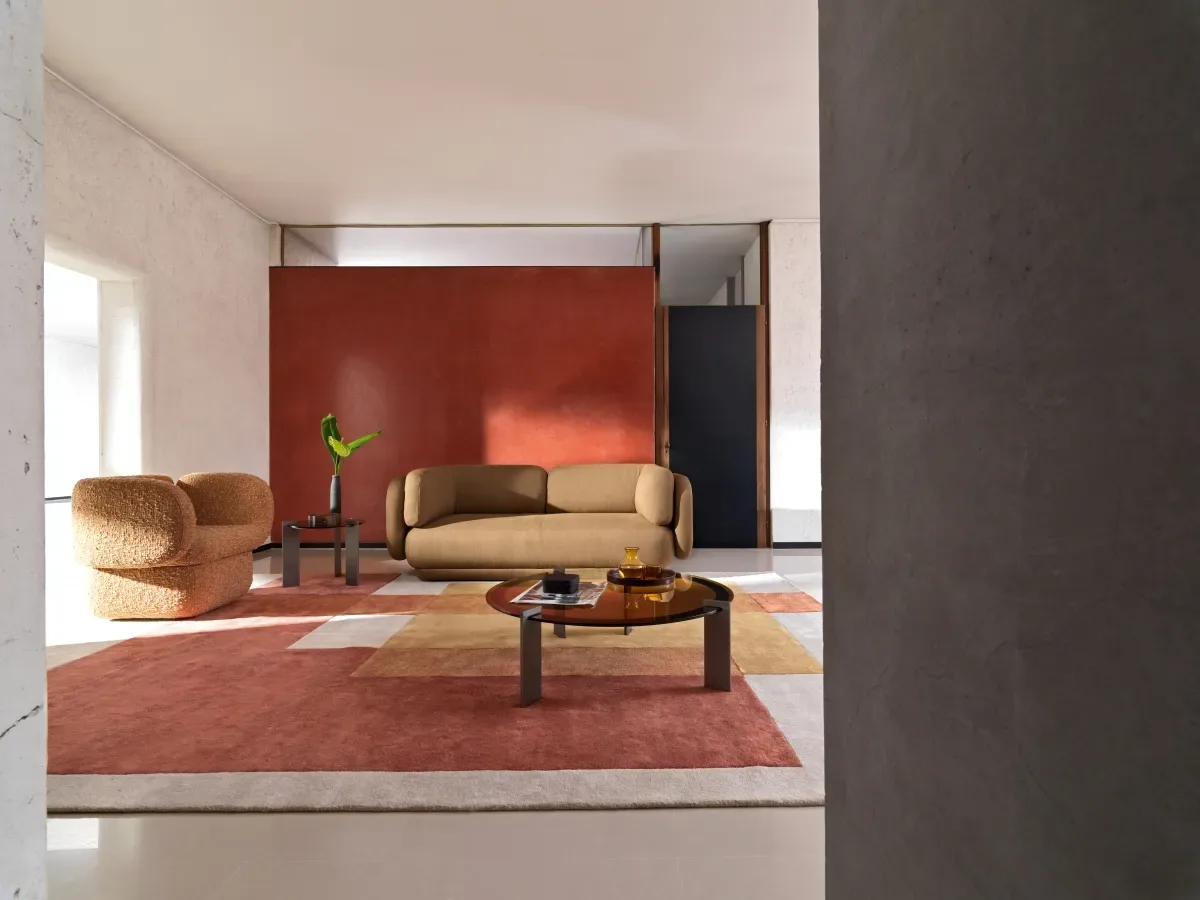
One of the most effective ways to introduce soft lines is to select a single principal element. It may be the sofa, an armchair, a coffee table, a rug or a substantial light fitting.
When the sofa takes the leading role, the other furnishings should support its design without copying it literally. A linear sideboard, an essential media wall or a simply shaped rug can provide the contrast needed to make the curve legible.
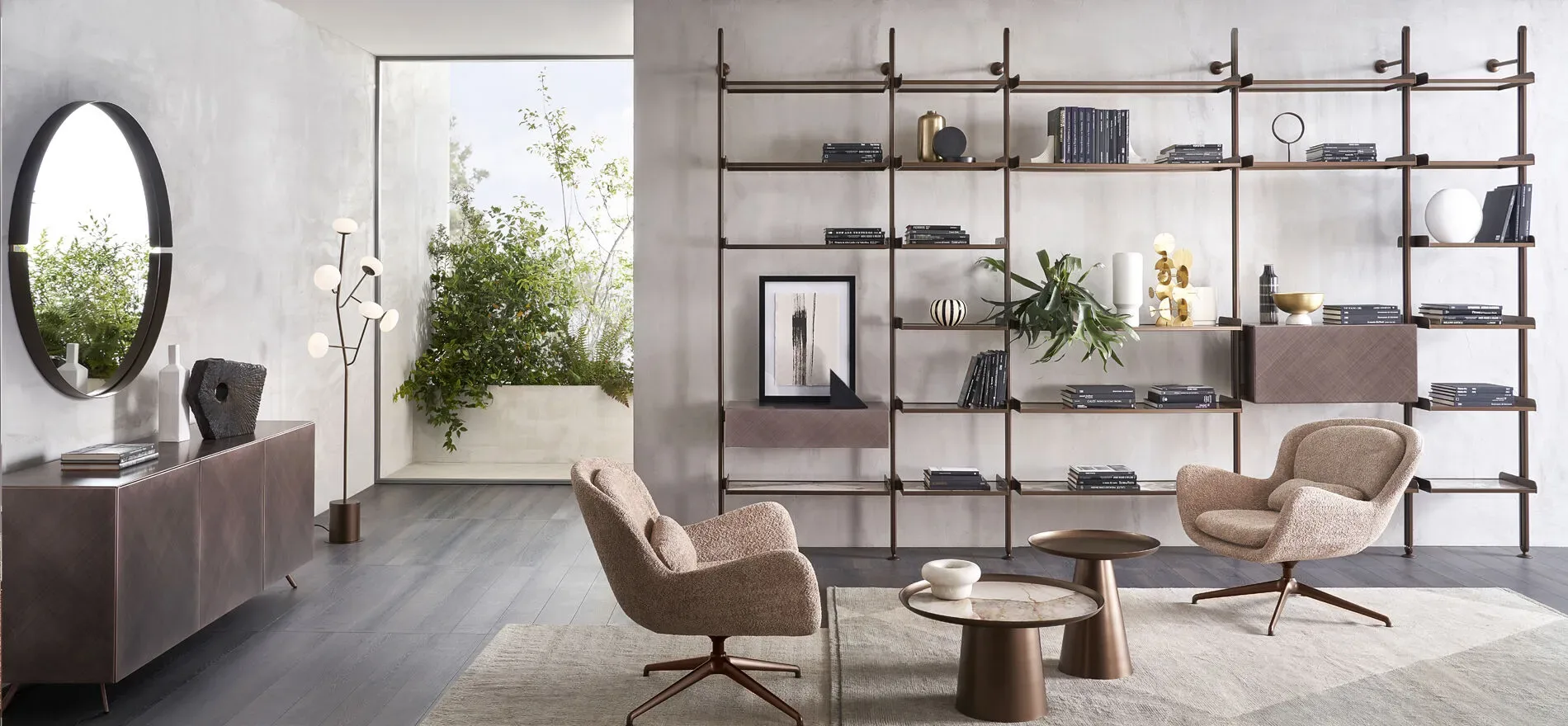
If the room already has a clearly defined structure, one accessory may be enough. An armchair with a wraparound back adds softness without changing the entire layout. Round or elliptical tables remove corners from circulation zones and relate easily to linear seating. An arc floor lamp can visually connect the central area with an off-centre light source.
Selecting a protagonist prevents every object from competing for attention. A strong form needs quieter elements around it, otherwise the living room loses hierarchy.
Curved sofas and the conversation area
The sofa changes the perception of a living room more than any other element. A curved configuration or a composition of connected modules can encourage conversation because it angles people towards a shared centre and reduces the rigidity of perfectly aligned seats.
Not every curve creates the same effect. A gentle arc maintains efficient use of space and can suit medium-sized rooms. A semicircular composition creates a more enclosed area but needs greater depth and sufficient distance from the wall. Independent organic modules offer more freedom, but require a rug or a group of tables capable of unifying the arrangement.
The number of genuinely usable seats must also be checked. A strongly curved profile may interrupt seating continuity or create points where people sit too close together. The quality of a composition is therefore measured not only by the originality of its outline, but by its capacity to provide natural postures and appropriate distances.
The back is particularly important. Seams, module junctions, feet and upholstery must be finished to a standard suitable for exposure when the sofa stands in the centre of the room.
Balancing curves and straight lines
An interior built entirely around rounded shapes can lack tension. Contrast with straight lines, horizontal planes and more rigorous surfaces makes the curves clearer while maintaining order.
One possible hierarchy is to assign:
- soft lines to upholstered furniture and movable accessories;
- straight geometry to storage and architectural elements;
- an intermediate form to the rug or lighting system;
- a few curved references to secondary details, without automatic repetition.
The relationship does not need to be symmetrical. One broad curve can balance several orthogonal elements because its visual weight is greater than that of small rounded details distributed around the room.
Placement also contributes to balance. A curved sofa facing a linear media wall creates a clear relationship between a soft seating zone and an architectural backdrop. By contrast, placing organic seating in front of a wall already fragmented by niches, shelves and decoration may produce an excess of information.
The role of empty space
Organic forms need to be perceived along their perimeter. When placed too close to walls or other furniture, their outline loses clarity and becomes merely an awkward footprint.
Leaving empty space around a curved element is not a waste of floor area. That margin makes the design understandable, facilitates movement and connects the furniture with the light. In a small living room, it may therefore be better to choose one controlled organic piece rather than compress a large composition between the walls.
Empty space should be distributed intentionally. A wider route along the convex side can support circulation, while a more intimate distance in front of the seats keeps the table within easy reach. The aim is to avoid both overcrowding and dispersion.
Coffee tables, rugs and complementary elements
Accessories help make an organic arrangement functional. A round table has no exposed corners and can be reached from several positions, but its diameter must relate to the seating. In complex compositions, two or three tables at different heights are often more effective than one very large surface.
The rug can follow the sofa’s curve, contrast with it or create a neutral boundary. A round rug emphasises the centre of conversation, but may feel too small in front of a long composition. Oval or irregular shapes accompany extended profiles more naturally; a rectangular rug, on the other hand, provides a stable base and contains the expressive quality of the upholstered furniture.
Complementary seats also require careful orientation. A swivel chair can relate to the sofa and, when necessary, turn towards the television or window. A backless pouf maintains open sightlines and can move to different points in the arrangement.
Materials and textures that enhance soft forms
Upholstery affects the reading of a curve. Compact, slightly elastic fabrics follow the profile continuously and limit unwanted creasing. Very rigid weaves or strong geometric patterns may be difficult to align, particularly at seams.
Bouclé, chenille and tactile fabrics heighten the enveloping quality, but should be judged for abrasion, cleaning and long-term behaviour. A pronounced texture increases perceived volume; on an already generous sofa, a uniform and moderately contrasted shade may be more appropriate.
Leather highlights seams and develops a patina that reveals areas of frequent use. On curved surfaces it demands precise workmanship, because tension and junctions become part of the design. View sufficiently large samples and examine how the material responds to grazing light.
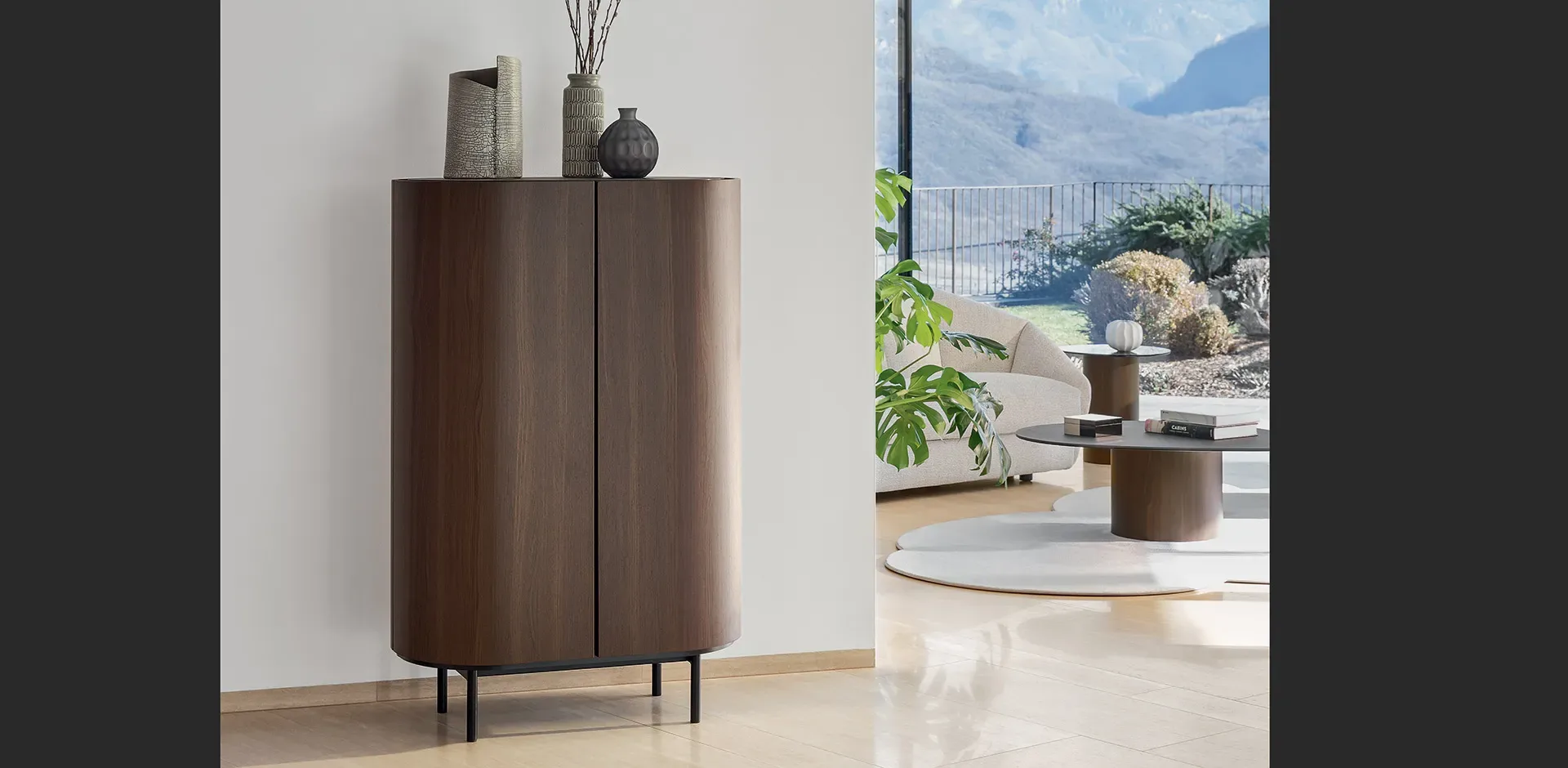
For tables and storage, wood, stone, glass and metal can provide a counterpoint. A stone top with a rounded edge retains a solid presence; glass reduces visual weight; wood introduces warmth and makes the transition between organic forms and architectural geometry more natural.
Colour and visual continuity
Curved forms already draw attention through their outline. A highly saturated colour amplifies that presence and must be calibrated to the room’s dimensions.
Neutral shades, earth tones, muted greens and mineral colours encourage a continuous reading of the volume. They do not necessarily make a room anonymous: variations in texture, light and material can create depth within a restrained palette.
If a strong colour is desired, establish a hierarchy. The sofa can become the main chromatic focus while the rug, curtains and walls remain quieter. Alternatively, the large seat can stay neutral and colour can be assigned to an organic armchair or smaller accessories.
Repeating the dominant shade in minimal amounts helps integrate the element: a detail in an artwork, a cushion or an object on the table is often enough. Repetition should remain discreet rather than becoming a mechanical matching exercise.
Lighting curved surfaces
Light reveals three-dimensional form. Uniform frontal illumination tends to flatten volumes, while soft side light creates gradations and makes junctions and depth legible.
In the living room, combine general lighting, atmospheric lamps and task lights for reading. A central pendant does not always correspond to the centre of the composition, particularly when the sofa is curved or off-centre. Arc floor lamps, adjustable fittings and indirect sources adapt the light to the actual seating geometry.
Avoid excessive reflections from glossy or glass tables and control shadows cast by substantial pieces. Light should accompany the form without turning it into a permanent theatrical effect.
Organic forms in compact interiors
In a small living room, softness can improve circulation by removing projecting corners from busy areas. This does not mean that every curved piece is suitable for a reduced space.
Generally manageable options include:
- linear sofas with rounded arms;
- soft end units rather than complete semicircular compositions;
- small-diameter round tables;
- compact armchairs with swivel bases;
- easily movable oval or irregular poufs;
- rugs with rounded corners that do not visually reduce the room.
Avoid very deep curves pushed against a wall, as they create residual spaces that are difficult to clean and use. A compact organic form that can be read from several sides can instead become a point of quality without compromising the available area.
Mistakes to avoid
The first mistake is to confuse softness with a lack of structure. A living room still needs alignments, focal points and recognisable routes.
A second mistake is repeating the same form in every element: curved sofa, round rug, circular tables, spherical lamps and rounded storage. Coherence comes from relationships between different elements, not from replication.
It is also risky to decide from the front view alone. Organic furniture occupies space three-dimensionally and must be assessed from the entrance, side routes and adjacent areas.
Other points to check include:
- the actual number of seats;
- the reachability of tables;
- distance from doors and windows;
- the ability to clean behind and beneath elements;
- the quality of the back when exposed;
- compatibility between upholstery, seams and curvature;
- the balance between formal presence and room size.
A soft yet clearly designed living room
Organic forms can make the living room more welcoming and dynamic, provided they are used with restraint. Their effectiveness depends on their ability to direct movement, build relationships between seats and soften architectural rigidity without erasing structure.
The most balanced result often emerges from the meeting of opposites: curves and straight lines, soft surfaces and solid planes, substantial volumes and empty space. Each element retains its identity while contributing to a coherent whole.
A soft line should not be added simply because it is recognisable or current. It must tangibly improve how the room is crossed, observed and inhabited. When form, proportion, comfort and materials work in the same direction, the living room acquires a contemporary character capable of lasting beyond a single trend.