The Contemporary Sideboard: Storage Without Interrupting the Lightness of the Living Room
The contemporary sideboard stores everyday objects without weighing down the living room: proportions, materials, openings and placement help maintain order and visual lightness.
The Contemporary Sideboard: Storage Without Interrupting the Lightness of the Living Room
The contemporary sideboard answers a very practical need: storing tableware, documents, devices and everyday objects without turning the living room into a sequence of heavy volumes. Its value does not depend only on capacity, but on the relationship between footprint, proportions, openings, materials and wall. A well-designed piece stores a lot while still allowing the space to breathe.
Lightness does not necessarily mean small dimensions. A long sideboard can look orderly if it has a controlled height, a recessed base and continuous surfaces. Conversely, a small unit can appear visually heavy when it combines too many colours, handles, divisions and thicknesses. The project must therefore balance internal function and external perception.
Defining what it needs to contain
Before choosing dimensions and finishes, it is useful to list the objects to be stored. Plates and glasses require stable shelves and adequate depth; tablecloths and accessories work well in drawers; documents and small devices need more compact compartments. If the sideboard houses electronic equipment, ventilation, cable passages and access to sockets are essential.
Capacity should be assessed in useful internal volume, not only in external width. The thickness of doors and sides, drawers, plinths and hardware reduces the internal space. It is preferable to measure the largest items and check the permitted shelf load, especially for tableware, books or heavy collections.
A coherent distribution prevents the unit from being oversized. If each category has a precise place, capacity is used better and order is maintained. Very large generic compartments may seem flexible, but they often create overlaps that are difficult to manage.
Choosing the position in the living room
The sideboard can accompany a wall, define the dining area or act as a separating element in an open space. Its position should be chosen in relation to circulation routes and activities. Near the table it makes tableware and textiles easier to use; along a living-room wall it can store technology, books and objects; in the centre of the room it requires a carefully finished back.
There must be enough space in front of the unit to open doors and drawers and to move while taking out objects. In a passage area, projecting openings can become obstacles. The distance from table and chairs should also be considered when chairs are pulled back.
The wall should not automatically be filled from side to side. Lateral margins allow the outline to be read and leave room for a lamp, an artwork or simply empty space. Precise placement strengthens the presence of the piece without increasing its mass.
Proportions between length, height and depth
Lightness comes above all from proportions. A low, long sideboard extends the horizontal line and can make the living room feel wider. A taller model occupies less wall width and increases capacity, but requires greater attention to visual weight and to its relationship with pictures or lighting.
Depth must respond to the objects. A unit that is too deep invades circulation areas and creates internal zones that are hard to reach; one that is too shallow limits tableware and equipment. Even a few centimetres matter greatly in compact rooms, so the measurement should derive from the real content.
The relationship with wall height is equally important. Under a low ceiling, a very tall volume can feel compressive; in a spacious room, a sideboard that is too small loses presence. Paper silhouettes or masking tape help evaluate scale from the conversation area, the entrance and the table.
On the floor, on legs or suspended
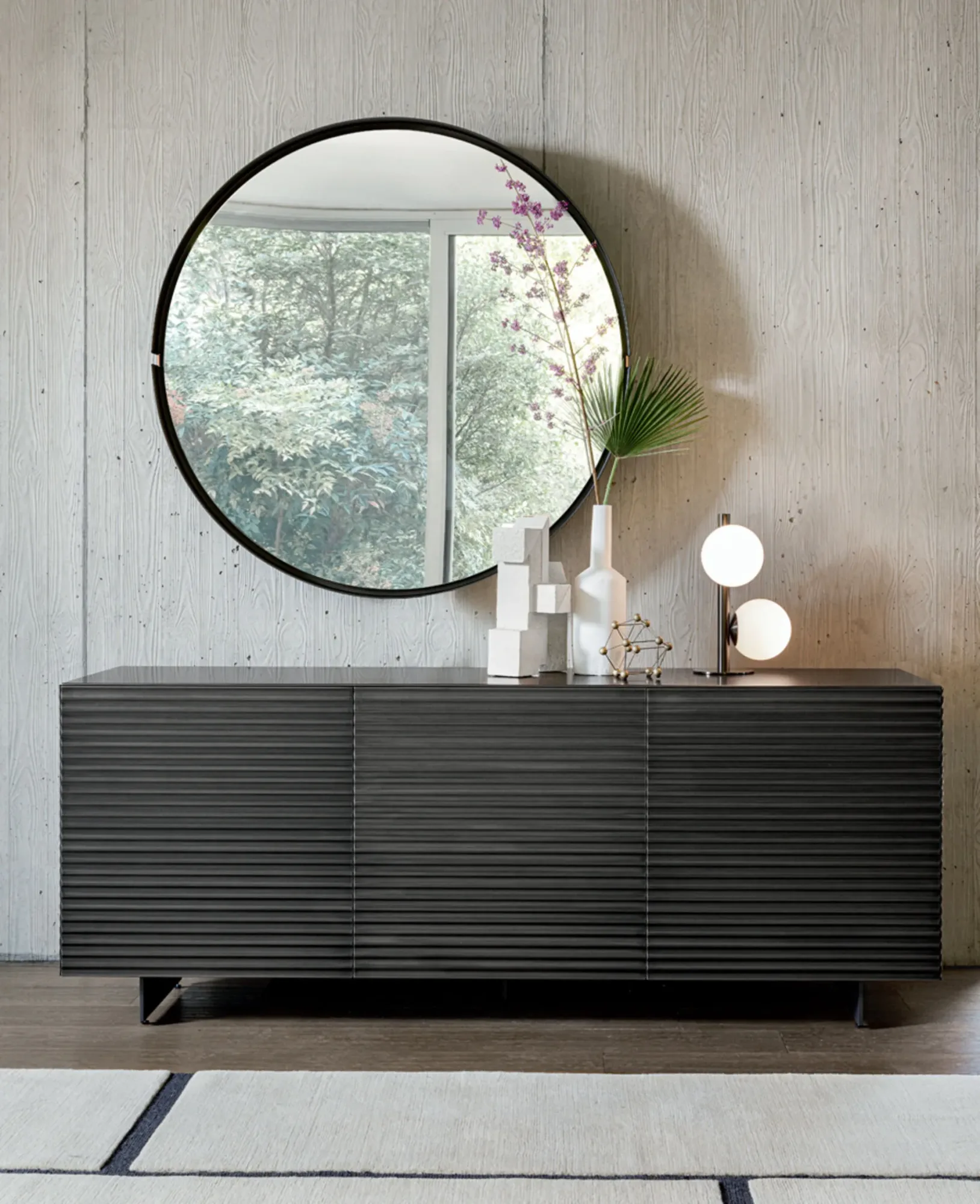
The way the unit meets the floor profoundly changes perception. A continuous plinth communicates stability and hides the space underneath. If recessed and dark, it can make the volume appear slightly raised. It is suitable when a compact and orderly base is desired.
Legs leave the floor visible and lighten the furniture. Height, number and section must be proportionate to length and load. Structures that are too thin may look fragile, while a well-sized frame creates continuity. The free space also makes cleaning easier if it is sufficient for the tools used.
A suspended solution completely frees the floor and reinforces horizontality. It does, however, require a suitable wall, correct fixing systems and respect for load capacity. Hidden systems and technical passages must be checked before drilling. Visual lightness must not compromise safety and capacity.
Doors, drawers and open compartments
Doors create continuous surfaces and conceal the contents, contributing to the order of the living room. Drawers make access easier for small or stacked objects. Open compartments break up the mass and allow a few elements to be displayed, but they require frequent cleaning and constant selection.
The best combination depends on use. A fully closed sideboard offers maximum visual calm; a central or lateral opening can lighten the composition and introduce depth. Too many different compartments fragment the front. It is preferable to establish a hierarchy, maintaining coherent alignments and rhythms.
The opening direction also matters. Hinged doors need front clearance; sliding systems reduce the footprint but allow access to only one part at a time; flap doors can become temporary surfaces, provided the hardware and load capacity are adequate.
Handles, grooves and push openings
The choice of opening system influences the language of the piece. Visible handles can introduce rhythm and tactile quality, but they must be proportionate and must not obstruct passage. Grooves and integrated profiles keep the front continuous, requiring a comfortable grip and precise workmanship.
Push-pull systems eliminate external elements and make the sideboard more essential. They are suited to clean surfaces, but should be assessed in relation to everyday use: fingerprints, adjustments and ease of opening vary depending on material and frequency of use.
The lightest solution is not always the most invisible. Sometimes a thin, well-designed handle clarifies the gesture and enriches the furniture without making it heavier. What matters is consistency with the rest of the living room: doors, kitchen, table, lighting and metal details.
Materials and colours
Matt finishes, natural woods, light lacquers and continuous surfaces help reduce visual weight. Dark tones can work very well if the volume is proportionate and the room has enough light. Colour should not be chosen in isolation, but in relation to flooring, walls, sofa, table and window frames.
Wood introduces warmth and can feel light if the grain is orderly and the composition is not too fragmented. Lacquers and textured surfaces offer a more architectural image. Glass, metals and decorative inserts can add depth, but should be used with restraint so the sideboard does not become the loudest point in the room.
Chromatic continuity with the wall softens the presence of the piece; contrast highlights it. Both choices are valid if intentional. In small rooms, a sideboard close to the tone of the wall can store a lot without closing the space.
Relationship with wall, light and objects
A sideboard does not live alone. A lamp, a picture, a mirror or a few selected objects can sit above it. The composition should leave breathing room: if every centimetre is occupied, the piece loses its function of order and becomes a chaotic display.
Lighting can enhance materials and proportions. Grazing light highlights textures and volumes; a table lamp creates a domestic focal point; overly strong spotlights may instead emphasise reflections and shadows. The choice depends on finish and position.
The rear wall is also part of the project. Panelling, a deeper colour or a discreet wallpaper can provide a frame. In other cases it is better to leave the wall neutral to emphasise the cleanliness of the furniture. Balance comes from the relationship between solids and voids.
Avoiding the storage-dump effect
The main risk is using the sideboard as an undefined container. When everything that has no place ends up in the same unit, order becomes temporary. Before buying, it is worth establishing precise functions: table service, documents, technology, textiles, games, seasonal objects.
Internal accessories, dividers and adjustable shelves improve everyday use. Many fittings are not necessarily needed, but the right ones are. An organised drawer is often more useful than a large compartment with no subdivisions.
The top surface should remain partly free. An overloaded top increases visual weight and makes cleaning difficult. A few elements, spaced and coherent, allow the sideboard to contribute to the calm of the living room.
Conclusion
A contemporary sideboard works when capacity does not compromise lightness. Measurements, proportions, floor support, openings, materials and position must be considered together. It is not simply a matter of hiding objects, but of giving them a precise place inside a balanced volume.
In the living room, the best sideboard is the one noticed for its order and measure, not for its bulk. It contains what is needed, dialogues with the wall and leaves room for everyday life.