Contemporary comfort: support, softness and seating ergonomics
Comfort depends on the balance between support, softness and posture. Learn how fillings, proportions and ergonomics shape a pleasant, durable seating experience.
Comfort is not a single sensation
When testing a sofa, the judgement may seem immediate: comfortable or uncomfortable. In reality, comfort results from many factors that work together and become fully apparent only through use. Seat height and depth, backrest angle, cushion density, lumbar support, structural elasticity and upholstery characteristics all change posture and the way the body distributes its weight.
Maximum softness does not therefore mean maximum quality. A very yielding seat may feel pleasant during the first few minutes but become tiring if it lacks progressive support. A firmer seat can initially appear disciplined and prove well balanced during a long conversation or when the user stands frequently. Contemporary comfort seeks a coherent relationship between the body, activity and duration of the experience.
Support and softness should work together
Support and softness are often treated as opposites. In a well-designed seat they perform complementary functions. The upper layer receives the body and reduces pressure points, while the layers beneath control how far it sinks and maintain stability. If the surface is excessively firm, weight becomes concentrated in a few areas. If the entire cushion is too yielding, the pelvis drops too far and the spine loses support.
The ideal response is often progressive: soft at first contact and more supportive as weight is transferred. This behaviour can be created by combining foams of different densities, fibres, wadding or other materials. Quality cannot be judged from cushion thickness alone. Internal composition, shape recovery and long-term stability all matter.
The base affects the result as well. Elastic webbing, springs and structural panels provide different responses. The system should distribute loads without creating overstressed areas and should work in harmony with the cushioning.
Measurements that guide posture
Usable seat depth determines how much of the thigh can be supported while the back remains in contact with the backrest. If it is excessive for the user’s height, the body tends to slide forward or the feet cannot rest on the floor. Loose lumbar cushions can temporarily reduce depth and help the same seat accommodate different people.
Height from the floor influences how easily a person sits down and stands. Low seats communicate informality and encourage reclining, but they may be demanding for older people or anyone with limited mobility. A higher, more supportive seat makes the transition to standing easier.
Compression also changes effective height. The nominal figure must be compared with the behaviour of the cushioning under load. Depth, height and inclination cannot be assessed separately.
Backrest inclination
A more upright back supports conversation, reading and attentive activities. A wider angle invites relaxation and distributes weight over a larger area. No inclination is ideal for every activity, so design should begin with the principal use.
Adjustable backs, bolsters and loose cushions allow posture to vary. A mechanism should be intuitive, stable and accessible. A function requiring awkward actions will be used infrequently and add complexity without real benefit.
The trial should include several positions. Check whether the lumbar area remains supported during relaxation and whether the head can rest without pushing the chin forward. Comfort depends on continuity between pelvis, back and upper body.
Lumbar support
The lumbar region needs support that follows the natural curve of the back without pushing it forward. A gap in this area often causes the pelvis to rotate and the spine to round. A correctly sized cushion fills the distance but should not be so large that it excessively reduces the seat.
People of different heights need different support. Movable cushions offer greater adaptability than a fully fixed back, but require stability. If they slide or quickly deform, support changes during use.
Lumbar cushion density should support without creating a hard point. A very soft material compresses and loses function; one that is too firm may feel intrusive. A personal trial remains essential.
Shoulders, head and arms
Low backs preserve long sight lines and make a centrally positioned sofa appear lighter. They provide limited support for shoulders and head, however. Lift-up headrests or movable elements increase support when needed while retaining a low profile at other times.
Mechanism quality matters. It should move precisely, remain stable in the chosen position and be simple to operate. Even when lowered, it should not create uncomfortable projections or misalignment.
Armrests participate in posture. Height and padding should allow the forearm to rest without lifting the shoulder. Low arms encourage use as a side pillow, while structured ones help users maintain a composed position. The choice depends on habits rather than image alone.
One sofa, several ways of sitting
The contemporary home accommodates different activities in the same room. People converse, read, watch films, work briefly and stretch out on the sofa. Assuming that one posture can satisfy every use often produces ineffective compromises.
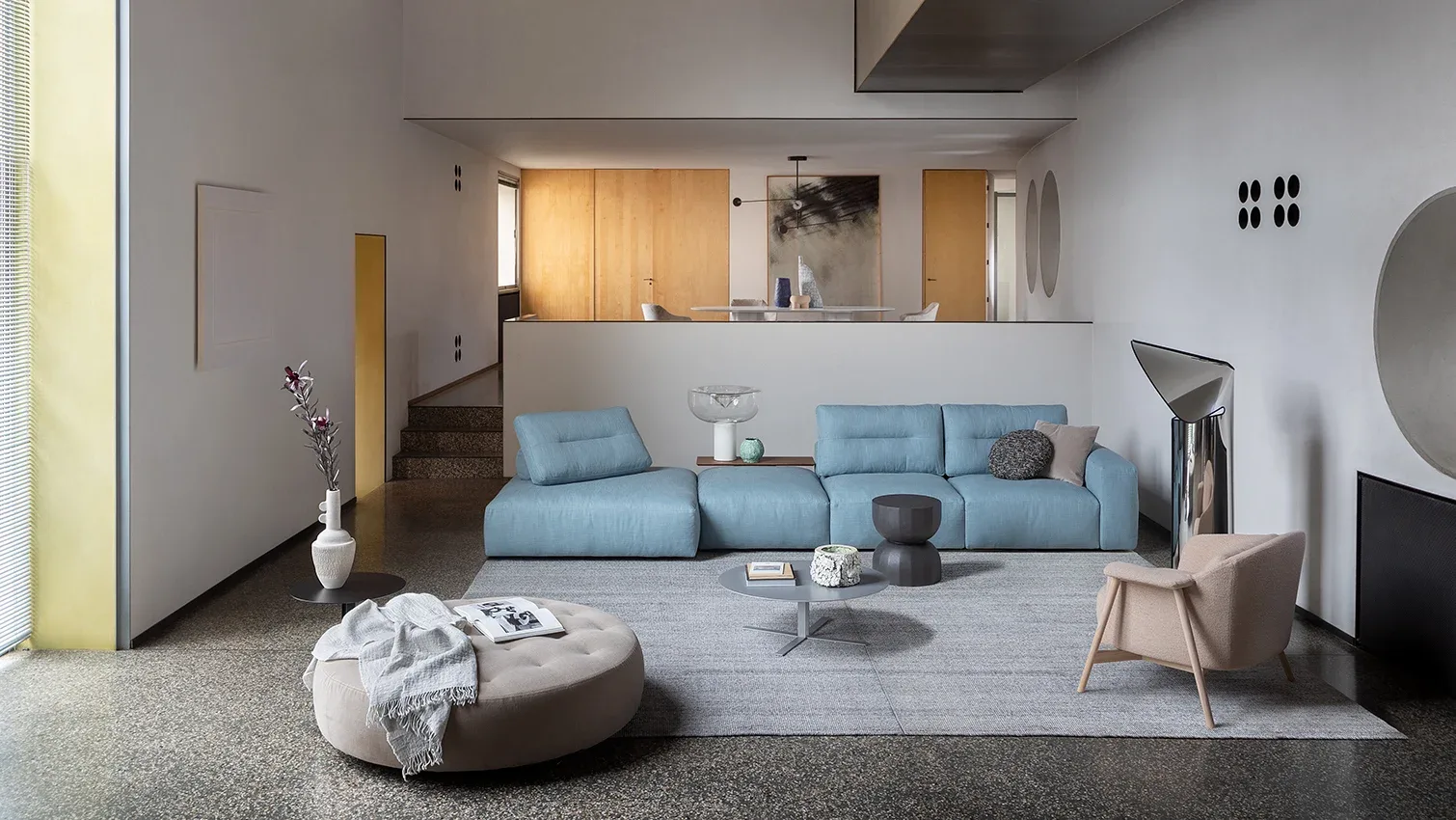
Modularity can distribute different functions within one composition. A regular seat supports conversation, a chaise longue accommodates reclining and an ottoman temporarily extends the support surface. Loose cushions allow individual adjustment.
This variety works when heights, junctions and densities remain coherent. Arbitrary differences create uncomfortable points and visual disorder. Movable elements also need somewhere to go when not in use.
Shared seating and independence
One long seat cushion creates visual continuity but transfers movement between people. Separate cushions define more independent places and can be rotated to distribute wear. Seams and divisions should correspond to the structure rather than create arbitrary lines.
Place width also affects comfort. Seats that are too narrow restrict movement; very wide surfaces may leave poorly supported central areas if the construction is inadequate. The stated number of places does not by itself describe quality.
Where users have different builds, a combination of lumbar cushions and places with varied functions provides greater adaptability. The design should avoid making only one place genuinely comfortable.
Cushioning and behaviour over time
Foam density describes the relationship between mass and volume, but does not by itself indicate firmness. Materials of similar density can have different load-bearing capacity and elasticity. Assessing quality requires consideration of the complete design, recovery and the possibility of replacing parts subject to wear.
Fibres and feathers, where used, create softer reception and a more informal appearance. They require maintenance: cushions need to be plumped and turned to redistribute their filling. Anyone seeking a consistently regular surface may prefer more structured padding.
Some settling is normal over time. Slight initial softening is not necessarily a defect; localised collapse, pronounced differences between places or failure to recover deserve attention.
Upholstery and perceived comfort
The body meets a sofa through its upholstery, which affects temperature, friction and perceived softness. Tactile fabrics create a warm, enveloping sensation, while compact weaves convey greater precision. Leather responds to room temperature, adapts through use and develops a patina.
The decision should take account of domestic climate, exposure to light, children or animals and frequency of use. Abrasion resistance, colour fastness and ease of cleaning are concrete specifications to consider alongside handle and breathability.
Removable covers make deep cleaning easier and can extend useful life. It is necessary to establish which parts can actually be removed and which washing procedures are permitted.
Thermal comfort
Temperature and humidity influence the seating experience. An upholstery with limited breathability can feel unpleasant in warm conditions, while very open textiles may retain dust. The choice should suit the actual microclimate.
Direct sunlight can heat surfaces and alter some colours. Curtains and screening protect the material and improve comfort. Adequate distance from radiators and heat sources is also important.
Cushioning contributes to heat dissipation. Highly enveloping layers provide a warm, enclosed sensation; more supportive solutions facilitate small movements and ventilation. Well-being depends on the combination rather than one material.
Carrying out an informed trial
An effective trial requires time and natural behaviour. Wear everyday clothes and adopt positions used at home instead of sitting formally for a few seconds. Check whether the feet rest on the floor, whether the front edge presses behind the knees, whether the lumbar area is supported and whether standing requires excessive effort.
The test should involve the people who will use the sofa most often. Differences in height and build reveal needs that one person may not notice. Any adjustable mechanisms should be operated several times.
Remain seated for several minutes in every relevant position. First impressions reveal surface softness; time reveals the quality of support. Ease of moving from one place to another is also a useful indicator.
Comfort and living-room proportions
Well-being does not depend only on contact with the seat. A very deep sofa in a narrow room may feel comfortable to the body and uncomfortable for the life of the space. Restricted routes, tables placed too close and incorrect viewing distances create constraint.
Before purchase, mark the footprint on the floor, including modules, arms and the extension of any mechanisms. Simulate circulation, access to windows and the use of occasional furniture.
Rugs and lighting should support different postures. A reading lamp should not require twisting, while a nearby surface should be reachable without excessive leaning.
Maintaining comfort
Seating quality needs regular care. Gentle vacuuming removes dust and residue before they enter fibres. Marks should be treated promptly according to upholstery guidance.
Removable cushions can be turned and plumped to distribute wear. It is useful to alternate occupied places, especially where one receives far more use. Zips, seams and mechanisms deserve attention if they begin to change.
Unspecified products and unsuitable washing can alter handle, colour and dimensions. Care instructions belong to the decision: an appropriate material should suit the time and resources available for maintenance.
Mistakes to avoid
The first mistake is choosing solely according to softness felt for a few moments. The second is ignoring who will use the sofa and selecting a depth or height unsuitable for most of the household. Adding numerous cushions to correct poor geometry is equally risky.
It is also important not to consider every adjustable function essential. Mechanisms and moving parts have value when they answer a real need; otherwise they add complexity and maintenance. A few robust, integrated devices are preferable.
Finally, comfort should not erase form. Distorted padding, excessive cushions and arbitrary proportions weaken visual quality. Good design remains balanced while the sofa is being lived on.
A personal and lasting balance
Contemporary comfort succeeds when it supports without restricting and receives the body without taking away control. It comes from coherent dimensions, materials that work together and solutions suited to real habits.
This synthesis of ergonomics, construction quality and proportion allows the sofa to remain pleasant beyond first contact. Well-chosen seating accompanies different ways of living over time while retaining comfort, function and elegance.