Modular sofa: how to design a truly flexible conversation area
A guide to designing a flexible conversation area with a modular sofa, considering activities, space, modules, ergonomics, upholstery and construction quality.
Flexibility does not simply mean adding modules
A modular sofa is often chosen for the possibility of changing its composition over time. However, true flexibility does not depend only on the number of available elements, but on the quality of the overall project.
A successful conversation area must adapt to different situations: welcoming more people, encouraging dialogue, offering relaxed seating, keeping circulation routes clear and maintaining a balanced relationship with the rest of the room.
Modularity therefore becomes a design tool. It allows you to build a configuration that is consistent with the space, rather than adapting the room to a predefined composition.
Start from activities, not from the shape of the sofa
Before choosing modules, upholstery and dimensions, it is useful to understand how the living area will be used.
A living room intended mainly for conversation requires a different layout from a space organized primarily around the television. Likewise, a home where guests are often received will have different needs from a home used by one or two people.
The main questions to ask are simple:
- how many people usually use the sofa;
- how often guests are received;
- whether the living room is also used for reading, working or relaxing;
- whether a direct view of the television must be maintained;
- whether the composition will need to change over time;
- which routes must remain clear within the room.
This analysis helps avoid one of the most frequent mistakes: choosing a composition that is visually interesting but poorly suited to real domestic habits.
The relationship between sofa and available space
A modular sofa must be proportioned not only to the surface area of the living room, but also to its geometry.
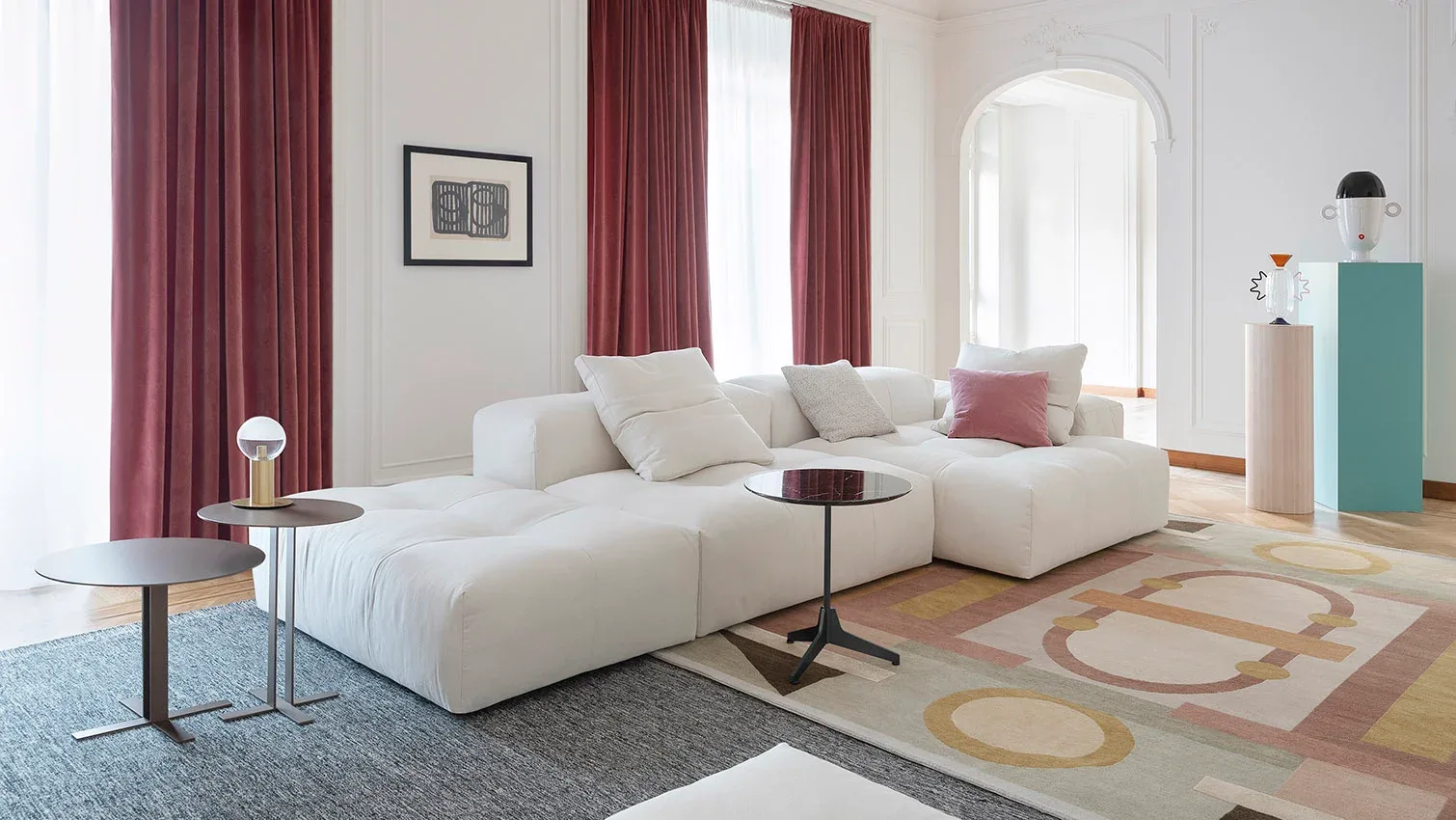
In a rectangular room, a linear composition with chaise longue can follow the direction of the space and clearly define the relaxation area. In a wider and more regular space, on the other hand, an angular or open configuration can allow a greater variety of uses.
In open-plan spaces, the sofa can also take on an architectural function. Positioned in the centre of the room, it helps visually separate the living area from the dining area or kitchen without introducing walls.
In this case, the back of the composition must also be carefully evaluated. Backrests, stitching and upholstery must be designed to remain visible, because the sofa is no longer perceived only from the front.
The distance from other furniture is equally important. Comfortable, continuous passageways must remain around the composition, avoiding corridors that are too narrow or interrupted routes.
How to choose the modules
The quality of a modular system is measured by the variety and consistency of its elements.
The most common modules include:
- central seats;
- end elements;
- corners;
- chaise longues;
- dormeuses;
- poufs;
- modules without backrests;
- curved elements;
- integrated tables or surfaces.
It is not necessary to use many different types. An effective composition can also be built with just a few elements, provided they are chosen consciously.
Central modules increase the number of seats available and allow the length of the sofa to be extended. End elements, instead, define the relationship between the composition and the surrounding space.
The chaise longue offers a stretched-out seat, but occupies a significant surface area. It must therefore be positioned so as not to obstruct doors, windows or main routes.
The pouf is one of the most versatile elements. It can work as a footrest, extra seat, support surface or temporary extension of the composition. Precisely because of this mobility, it is particularly useful in rooms that need to adapt to different situations.
Open configurations and more enclosed configurations
The arrangement of the modules directly influences the way people interact.
A linear composition directs the gaze in the same direction and is suitable for rooms where the television, fireplace or outside view represents the main focal point.
An angular configuration, instead, creates greater proximity between people and encourages conversation. Users can look at one another more easily without having to adopt uncomfortable postures.
Opposing compositions, created with two sofas or separate modules, are particularly effective in large living rooms. They create a defined and symmetrical conversation area, but require enough space to avoid a feeling of crowding.
Open configurations, with elements facing different directions, are more informal and dynamic. They are suitable for open-plan and multifunctional rooms, where the living area interacts with several areas of the home.
The importance of distances
The distance between seats determines the comfort of conversation.
Elements that are too far apart make dialogue less natural, while an excessively close arrangement can limit movement and create a feeling of constraint.
The central coffee table must also be proportioned to the composition. It should be easy to reach, while leaving enough space to sit down and stand up comfortably.
With mobile modules, it is advisable to provide a free area that allows them to be moved without reorganizing the entire living room. Flexibility, in fact, is useful only when it can be used easily.
Seat, depth and posture
Modularity must not make ergonomics a secondary issue.
Seat depth affects the type of comfort offered. A deep seat encourages a relaxed and informal position, but may be less suitable for those who prefer a more supported posture. A shallower depth makes it easier to place the feet on the floor and offers a more upright position.
The height of the backrest also changes the user experience. Low backrests make the sofa visually light and help keep the perception of space open. Higher ones offer greater support, especially in the neck area.
Some modular systems introduce movable backrests, repositionable cushions or adjustable elements. These solutions allow posture and seating direction to be changed without altering the entire composition.
Flexibility thus also becomes ergonomic, not only spatial.
Upholstery suitable for a dynamic composition
A modular sofa is often used intensively and may be reconfigured several times. For this reason, upholstery should be chosen by considering resistance, maintenance and behaviour over time.
Fabrics with a compact weave tend to withstand daily use better and limit the risk of surface deformation. More pronounced textures can make small marks, creases and natural variations less visible.
Removable covers simplify maintenance, especially in homes with children or pets. However, it is important to check that removability really applies to all elements of the composition, not only to the cushions.
Leather offers an elegant and durable surface, but develops a characteristic patina over time. It also requires careful placement, away from direct heat sources and intense sunlight.
Whatever material is chosen, it is useful to consider colour consistency between the different modules. Elements purchased at different times may show slight variations in tone, due to production batches or the natural ageing of the upholstery.
Uniformity or colour combinations
The composition can be created in a single colour or with differentiated modules.
A uniform tone reinforces visual continuity and makes the sofa resemble an architectural volume. This solution is particularly suitable for essential interiors, where the composition must integrate discreetly.
Combining different colours can instead highlight modularity and make the conversation area more dynamic. To maintain balance, it is preferable to work with close tones, variations of the same palette or controlled contrasts.
Cushions can also introduce colour variations without changing the main structure. They therefore represent a more flexible tool for updating the atmosphere of the room over time.
The role of coffee tables and complementary elements
A conversation area is not defined only by the sofa.
Coffee tables, lamps, rugs and complementary seats contribute to building a functional and coherent whole.
A rug can visually gather the different modules and define the perimeter of the living area, especially in open-plan spaces. Its dimensions must be sufficient to create a clear relationship with the sofa. A rug that is too small tends instead to fragment the composition.
Coffee tables can be chosen in different formats and distributed near seating points. Several light elements are often more flexible than a single large central coffee table.
A swivel armchair or an independent seat can complete the conversation area and adapt to different occasions. However, it is important to avoid introducing too many movable objects, because flexibility should not turn into disorder.
Anticipating the evolution of the home
One of the main advantages of a modular system is its ability to adapt to future changes.
A move, a different living room layout or new family needs may require a different composition. For this reason, it is useful to choose collections designed to remain available over time and equipped with a sufficiently broad modular range.
It is also advisable to check:
- the possibility of purchasing additional modules;
- compatibility between elements produced at different times;
- future availability of upholstery;
- ease of disassembly and reassembly;
- the connection system between modules;
- replaceability of feet, padding and components.
A good system is not limited to being modular at the time of purchase, but maintains its adaptability throughout its entire life cycle.
Construction quality and stability
The possibility of separating the modules must not compromise seating stability.
Connection systems must keep the elements aligned during use, avoiding shifts or gaps between one module and another. At the same time, they must allow simple reconfiguration when necessary.
The internal structure must guarantee rigidity and durability. Padding must also correctly recover its shape, especially at the joints, where any sagging is more evident.
Particular attention should be paid to modules without armrests or backrests, which can be used from several sides. In these elements, construction precision and the quality of finishes become even more important.
Mistakes to avoid
One of the most common mistakes is overfilling the room. The availability of many modules can lead to overly extended compositions, reducing circulation routes and making the living room appear smaller.
Another mistake is choosing the configuration based only on the floor plan, without considering doors, windows, radiators, electrical sockets and lighting points.
The orientation of the seats must also be checked carefully. A composition may be correct in size, but not very functional if it forces users to constantly turn their bodies to talk or watch television.
Finally, it is useful to avoid purely theoretical modularity. If the modules are too heavy, difficult to disconnect or have no alternative position, the composition will probably always remain in the same place.
A flexible but visually stable project
The conversation area must be able to change without appearing temporary.
To achieve this, it is useful to identify some stable elements: the rug, the lighting, a main coffee table or a wall system. Around these references, the modules can be moved and reconfigured without losing coherence.
The most effective flexibility is not the one that constantly changes the room, but the one that makes several configurations possible without compromising proportions, comfort and aesthetic quality.
A well-designed modular sofa accompanies the evolution of the home, responds to different needs and maintains a balanced presence over time. Its quality is not measured only by the possibility of adding or moving elements, but by its ability to create a space that is truly suited to the people who live in it.