Contemporary sofa beds: what to assess beyond the opening mechanism
Beyond the opening system, sleep quality, seated comfort, footprint and maintenance all matter. This guide explains how to assess a sofa bed for everyday life.
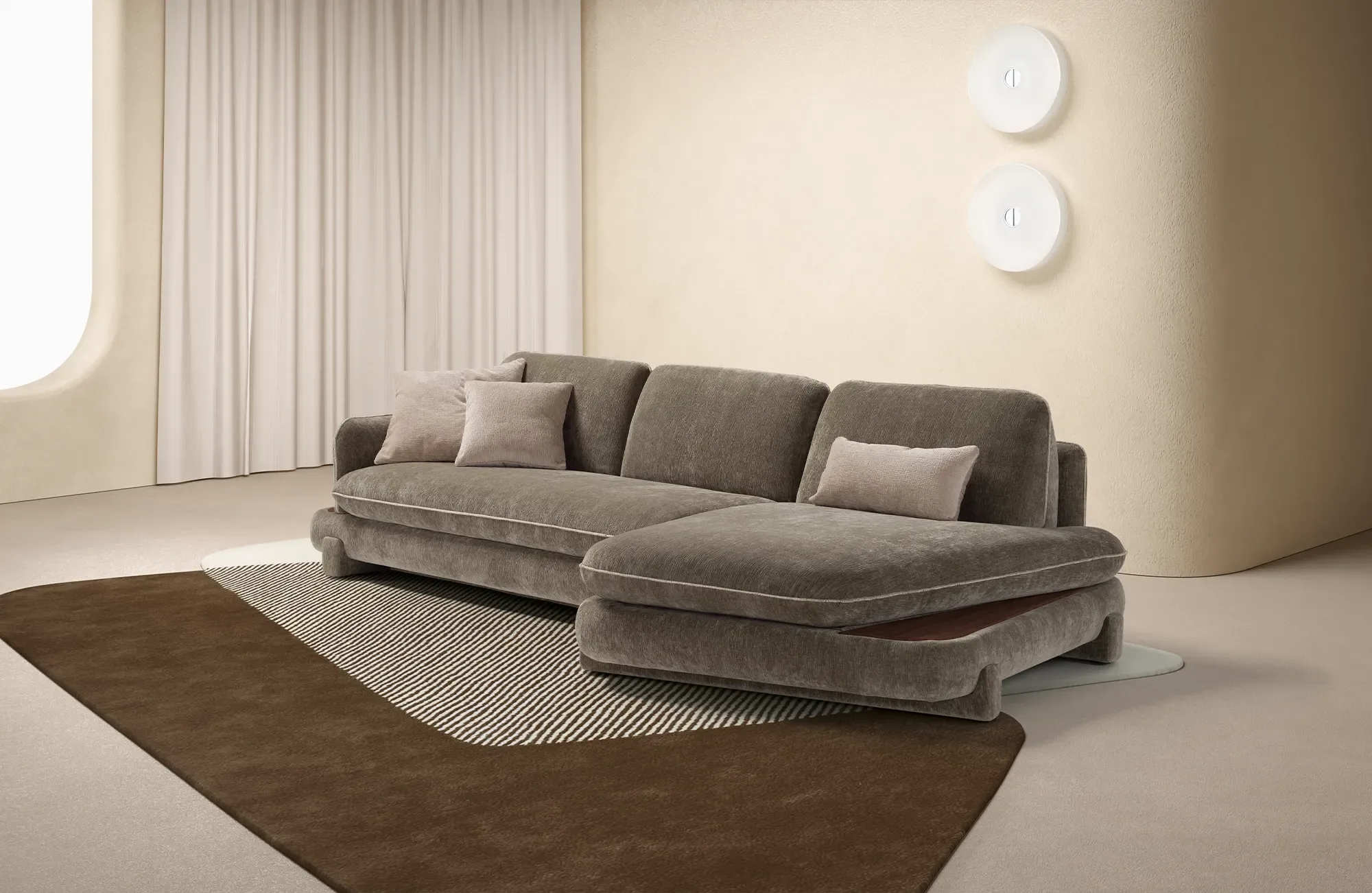
The opening mechanism is an important part of a sofa bed, but it does not determine quality by itself. A genuinely successful design needs to work as seating during the day, provide appropriate rest when transformed, and fit into the living room without looking temporary. Comfort, proportions, mattress, structure, upholstery, and maintenance all contribute to the same result.
The right choice also changes according to frequency of use. A solution intended for occasional guests may prioritise compact dimensions and flexibility. A bed used regularly demands greater attention to night-time ergonomics, ventilation, and component durability. Before comparing sizes and finishes, it is therefore necessary to define the role that the furniture will play in the home.
Clarify frequency and type of use
The first question is not about opening but about habits. Will the bed be used a few times a year, every weekend, or every night? Will it accommodate one person, a couple, adults, or children? Will the living room remain usable when the bed is open, or will it be fully transformed? The answers establish priorities.
For daily use, the mattress must support correct posture and retain its properties over time. The sleeping platform, junctions, and ease of ventilation also become central. For occasional use, a greater compromise on thickness may be acceptable, provided that comfort remains reasonable and transformation does not require complicated effort.
Consider who will prepare the bed as well. An older person or somebody with reduced mobility has different requirements from an occasional user. Component weight, grip height, and number of actions all affect the experience. Smooth opening is useful only when the entire sequence, including the handling of cushions and bedding, is straightforward.
Assess comfort as a sofa
A sofa bed generally spends more time closed than open. Seating should not therefore be treated as a secondary function. Height, depth, back angle, and padding quality must support the body during everyday activities such as conversation, reading, relaxation, or watching a screen.
The mechanism can influence the internal structure and make the seat firmer or less deep. This is not necessarily a fault, as some people prefer decisive support and a more upright posture. It is important, however, to test the sofa for long enough to ensure that the front edge does not compress the legs and that the lumbar area is supported.
Back cushions also deserve attention. Excessively soft cushions require constant adjustment, while very thin ones may reveal the structure behind them. Good filling, appropriate density, and maintainability contribute to lasting comfort. The transformable function should not be noticeable during ordinary daytime use.
Mattress thickness, support, and materials
The mattress is one of the main criteria and cannot be judged by thickness alone. Density, elasticity, weight distribution, breathability, and compatibility with the base all matter. A thicker mattress may offer greater comfort, but it has to fold without damage and return to its compartment without improper compression.
High-resilience foams can provide uniform support and low weight. Viscoelastic materials adapt to the body but may retain more heat and need a suitably ventilated base. Sprung solutions, where compatible with the system, support elasticity and airflow but often add weight and bulk. No technology is universally superior: frequency of use, body type, and personal preference should guide the choice.
The mattress cover affects hygiene and moisture regulation. A removable, washable cover simplifies care, while breathable textiles improve the microclimate. Before purchase, understand rotation, cleaning, and replacement instructions, as well as the future availability of compatible sizes.
The sleeping platform and continuity of support
Beneath the mattress, the base and structure determine stability and load distribution. Slats, metal grids, and mixed platforms produce different responses. A good base should prevent local sagging, noise, and noticeable differences between centre and edges.
Junctions require particular attention. Sleepers should not feel bars, hinges, or changes in level. The mattress needs continuous support and should remain stable when the body turns. Extendable feet and supports must reach the floor correctly without wobbling.
Load capacity is relevant as well. Check the recommended weight, particularly for regular use by two people. Strength does not depend only on the structural material, but also on connection precision and the system’s ability to retain alignment after many cycles.
Measure the room with the bed open
A common mistake is choosing the sofa according to its closed dimensions and discovering that it obstructs circulation once opened. The plan must include the full bed depth, space to move around it, and room for temporary bedside surfaces, lamps, or bedding storage.
Doors must still open, and windows, radiators, and balconies should remain accessible. In a compact living room, moving the coffee table may be necessary, but this action should be simple and the table should have a planned destination. If every transformation requires several pieces of furniture to be redistributed, the bed will be used less willingly.
Marking the open footprint on the floor with removable tape makes the remaining space clear. Simulate the night route to the bathroom and exit as well, checking for corners and narrow passages. The open configuration should be treated as a genuine mode of the room rather than an exception without design.
Proportions and aesthetic quality when closed
Transformability should not impose a technical appearance. A contemporary sofa bed can have essential lines, well-balanced volumes, and details consistent with the rest of the living room. Arms, base, and back should be assessed with the same care as any important seat.
Wide arms increase comfort and provide a support surface, but they add width without enlarging the mattress. In compact rooms, slimmer profiles release useful centimetres. A low plinth hides the structure and conveys solidity; taller feet lighten the volume and simplify some cleaning tasks, provided that they work with the mechanism.
The back matters if the sofa stands in the centre of the room. Continuous upholstery, precise seams, and concealed components allow it to separate living and dining zones. Aesthetic quality should be observed from every viewpoint rather than only from the front.
Upholstery suited to transformation
Frequent opening places stress on specific upholstery areas. Seams, edges, and panels near moving joints must withstand friction without distortion. A fabric suitable for intensive use, with good abrasion resistance and dimensional stability, helps preserve an orderly appearance.
Removable covers are useful, but it is important to know which parts can be taken off and how. Full removal may require more time, while detachable cushions and mattress covers simplify ordinary care. Washing instructions need to be followed to prevent shrinkage that makes refitting difficult.
Colour influences perceived volume and the visibility of wear. Very uniform shades reveal creases and shadows; mélange textures soften small variations. The choice should relate to the living room while supporting actual use. Samples viewed in natural and artificial light help assess both appearance and practicality.
Bedding, cushions, and storage
Bedding management determines how convenient transformation really is. If sheets, blankets, and pillows are stored in another room or a difficult compartment, preparation becomes more laborious. Provide nearby storage in a cabinet, pouf, or accessible part of the living room.
Not every system can close with bedding inside. Where this is possible, thickness limits and instructions must be respected to avoid forcing the mechanism. Otherwise, bedding needs a precise location. Breathable bags protect it from dust without trapping moisture.
The sofa cushions also need a place at night. Leaving them in circulation routes compromises order and safety. Before purchase, simulate the whole sequence: remove the elements, open the bed, prepare it, and restore the daytime arrangement.
Ventilation and sleep hygiene
A mattress enclosed within furniture requires attention to moisture. After use, it should be allowed to air before closing, especially when used frequently. Closing it immediately with damp bedding can cause odours and reduce hygiene.
The base should permit adequate air circulation, and the room should be ventilated regularly. Breathable mattress protectors safeguard the surface, while impermeable but poorly permeable layers can increase heat. Protection and comfort need to be balanced.
Periodic vacuuming, cover cleaning, and inspection of concealed areas support durability. Dust and small objects can collect near hinges and interfere with movement. Preventive maintenance is simple but depends on good accessibility.
Noise, stability, and movement quality
A sound system should remain quiet during opening, closing, and sleep. Creaking can result from loose connections, uneven supports, or wear. During testing, open the bed several times and sit on different edges while checking for movement.
The floor affects stability. Extendable feet should rest securely without damaging timber or delicate surfaces. Thick rugs may create level differences. Suitable protection and correct adjustment prevent movement and marks.
The quality of the action matters as much as speed. A controlled movement in which components support the weight is preferable to abrupt transformation. Handles and grip points should be accessible and free from edges that could catch fabrics or scratch users.
Delivery, access, and installation
Before selecting substantial dimensions, verify the delivery route. Door widths, stairs, lifts, corridors, and corners may restrict access. The mechanism often makes a sofa bed heavier and more rigid than conventional seating.
Find out which parts can be disassembled, including arms, back, base, or modules. Installation must be accurate because initial misalignment may affect opening and stability. Future maintenance also requires room to reach the components.
If the home may be reorganised or the furniture moved, construction modularity gains value. This does not concern daily transformation, but the ability to transport, repair, and reinstall the piece without compromising it.
Durability, assistance, and spare parts
Longevity depends on structural quality and the possibility of servicing parts exposed to wear. The mattress, straps, feet, springs, and moving components should be replaceable. It is reasonable to ask about warranty, assistance, and spare-part availability before purchase.
A robust mechanism still requires correct use. Weight should be distributed, opening should never be forced, and no object should remain trapped. Periodic checks can identify loose fixings or friction before they become more serious problems.
Repairability is also a sustainability criterion. Extending structural life by replacing the mattress or upholstery reduces the need to replace the complete piece. Durable design anticipates maintenance and renewal from the beginning.
Common mistakes
The first mistake is testing only the opening action. A simple movement cannot compensate for an uncomfortable seat or unsuitable mattress. The second is measuring only the closed sofa while ignoring circulation and services in the night configuration.
It is also risky to judge the mattress only by thickness without considering support, breathability, and base. Neglecting space for bedding and cushions makes use more complicated. Choosing delicate upholstery without considering friction and transformation frequency can quickly reduce visual quality.
Finally, the bed function should not be treated as purely emergency use if it will be needed frequently. Regular use demands the same rigour as a conventional bed: comfort, hygiene, durability, and ease of maintenance.
Two functions, one coherent design
A contemporary sofa bed succeeds when its two functions do not penalise each other. The seat should be comfortable and proportionate; the bed should offer support, stability, and practical organisation. Mechanism, mattress, and upholstery work together inside a room designed for both configurations.
Assessing frequency of use, dimensions, materials, ventilation, storage, and support leads to a more informed decision. The aim is not to conceal a secondary feature, but to integrate two ways of inhabiting the room within one orderly, durable, and genuinely convenient piece of furniture.