How to choose a statement bed without overwhelming the room
A bed with strong visual presence requires balance between scale, circulation, textiles and nearby furniture. Learn how to make it a focal point while keeping the room airy and coherent.
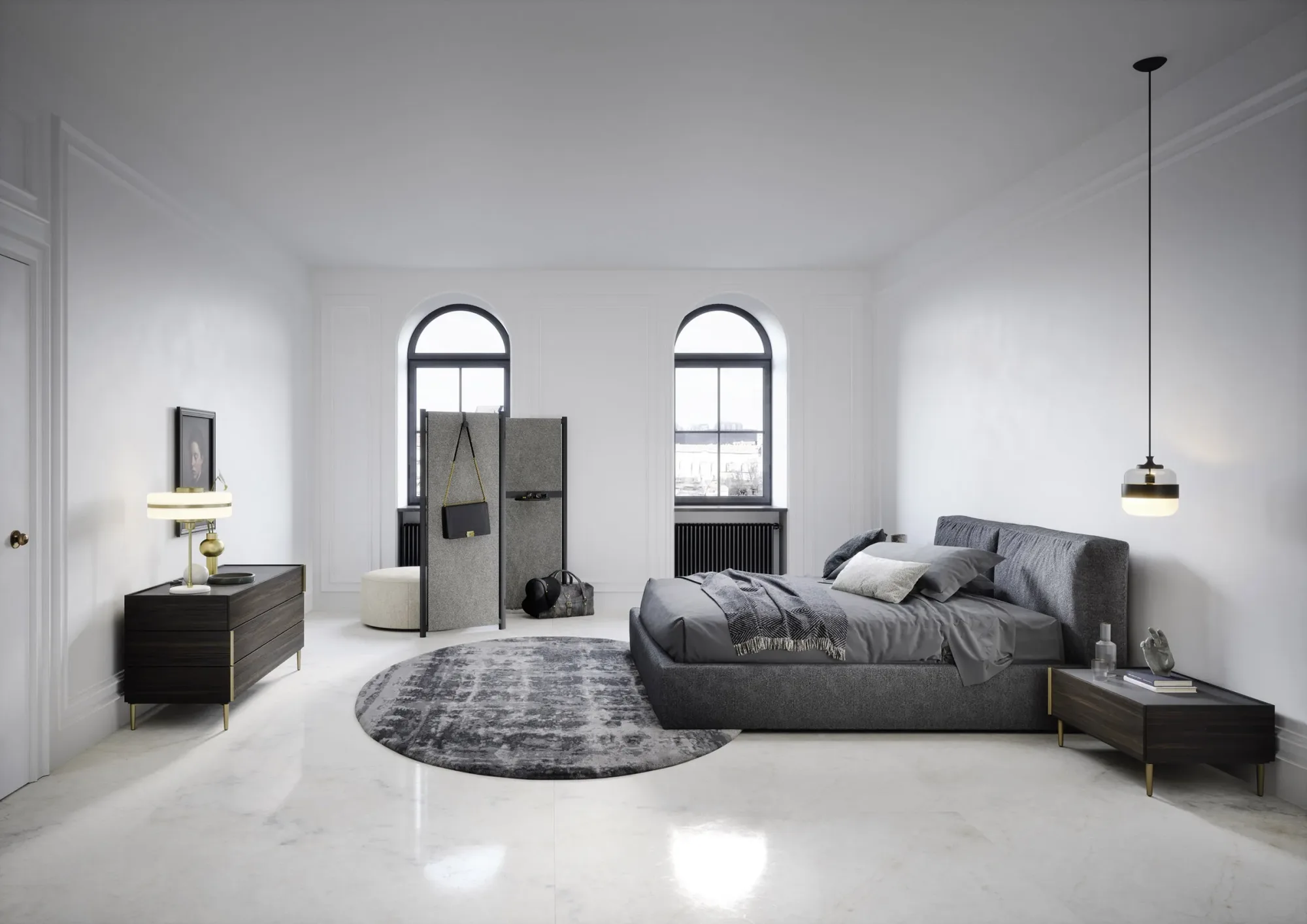
A statement bed can give identity to a bedroom, define the centre of the composition and improve comfort. Its presence must remain proportionate to the available volume. A tall headboard, generous base or tactile covering may become a high-quality feature, but without coordination with circulation, wardrobes, light and clear surfaces, the result can compress the room and make daily movement tiring.
Choosing a prominent bed does not mean selecting the largest or most decorated option. It means deciding which characteristic should lead and keeping the others controlled. Scale, more than absolute size, determines balance: the same bed may appear measured in a generous room and dominant in a compact one. The process should begin with a survey and an understanding of the whole interior.
Measure operating space
Mattress dimensions represent only part of the footprint. Frame, upholstery, headboard, feet and side projections add width and length. The design must also include room for making the bed, opening wardrobes and drawers, reaching windows and moving towards the bathroom.
Marking the full perimeter on the floor helps test:
- circulation on both sides;
- door and drawer opening;
- use of bedside units;
- access at the foot;
- the route from the door;
- space for curtains and radiators;
- possible use of seating.
The room should remain usable when two people move at once. Reducing passages for a few extra centimetres of base harms comfort every day.
Distinguish mattress size from perceived volume
Two beds with the same mattress can have very different presence. A slender raised base reveals the floor and appears light, while an upholstered structure extending to the ground creates a compact mass. A broad perimeter increases horizontal volume and requires more space.
The headboard further changes scale. A tall form concentrates attention on the wall, while a wide one extends the composition towards bedside units. Dark materials, pronounced textures and marked seams increase presence; tones close to the wall soften it.
Assessing perceived volume allows one strong characteristic to emerge without stacking several.
Establish one dominant gesture
A bed may be significant through its headboard, base, material or proportion. When every component competes, the composition becomes heavy. One dominant gesture should lead while the others support it.
Possible hierarchies include:
- broad headboard with restrained base;
- generous base with quiet headboard;
- tactile covering on simple forms;
- decisive colour within a controlled design;
- sculptural structure in a neutral palette.
This selection gives the bed identity without demanding equally prominent bedside units, lamps and textiles.
Proportion the headboard to the wall
The headboard should relate to free wall area rather than mattress alone. Doors, windows, recesses, sockets and lamps define the available field. A headboard that nearly touches a window by accident or leaves very narrow side strips appears out of scale.
A version matching bed width remains independent and suits articulated walls. An extended headboard can include side surfaces and lighting, creating an architectural background. In a small room, horizontal expansion may increase apparent width, but it still needs clear circulation and legible interruptions.
Visible height changes with mattress and pillows. Marking the outline on the wall helps evaluate the result before selection.
Choose height in relation to the ceiling
A tall headboard can strengthen verticality and suit a room with generous ceiling height. In a low interior, it may reduce visible wall and create pressure. The remaining distance to the ceiling should look intentional.
Artwork, lamps and panels should not be added automatically above an already substantial headboard. Leaving space can provide breathing room and increase the value of the main element.
Door position also affects perception. The first view should reveal balanced proportion rather than a volume that visually blocks the entrance.
Grounded or raised base
A raised base lightens the composition and continues the floor beneath. It requires stable construction, correctly sized feet and cleanable clearance. A base close to the floor appears more solid and may integrate storage, but adds perceived mass.
Under-bed storage offers useful capacity, particularly in compact bedrooms. Opening movement, mattress weight, access, ventilation and cleaning need testing. The function should not turn every use into a demanding action.
When the base is broad and upholstered, corners need protection and the passage must be sufficient. A projecting edge in a narrow route becomes an obstacle.
Materials and texture
Tactile materials increase the bed’s presence. Visible weaves, velvet, leather and quilted surfaces respond to light and create depth. In a small room, one distinctive texture in a controlled colour is often more effective than several patterns.
Timber, metal and upholstery can coexist when roles are clear. A wooden base may accompany an upholstered headboard, while slender metal details sharpen the design. Too many finishes compete with wardrobes, flooring and textiles.
Resistance should match household habits. Abrasion, sunlight, pets and cleaning all influence durability.
Colour: contrast or continuity
A bed contrasting with the wall becomes an immediate focal point and works best when the rest of the room stays calm. A tone close to the background reduces visual mass and emphasises form and texture.
Dark colours create depth and intimacy but absorb light and reveal pale dust. Very light tones enlarge the room while requiring more care with marks. Mid-tones often provide balanced presence.
Samples should be viewed with floor, wall, curtains and bedding. Textiles change often, so the principal covering should accept several combinations.
Bedside units and lateral furniture
A prominent bed needs side elements that are proportionate but not competitive. Very small units may appear residual, while massive volumes reduce circulation. Suspended solutions reveal the floor and lighten the composition.
When the headboard integrates ledges, useful area, height and socket access need testing. A restrained surface must still accommodate daily objects without becoming cluttered.
Wardrobe, drawers and seating should share a limited number of materials or colours. Repeating every bed detail makes the room rigid; a measured reference creates coherence.
Lighting and visual weight
Light can reduce or emphasise volume. A soft source behind the headboard creates depth and separates the bed from the wall. Grazing light reveals texture and seams but amplifies irregularities.
Reading lamps should follow actual pillow positions. Pendants and wall lights clear bedside surfaces and strengthen verticality, but they need proportion with the headboard.
Uniform general light prevents a dark base from becoming an indistinct mass. Separate circuits for reading, ambience and room illumination increase comfort.
Textiles that modulate presence
Linen, cushions and throws occupy a large visual field. If the bed has a strong form, controlled textile colours and textures maintain balance. When frame and headboard are quiet, bedding may introduce greater variation.
Numerous decorative cushions add volume and require storage when removed. The arrangement should remain sustainable in daily use rather than existing only for images.
Light layers and natural materials create depth without heaviness. The palette can connect bed, curtains and rug without rigid matching.
Rug and flooring
A rug can define the bed zone and balance a substantial structure. It should extend enough to be perceived at the sides and foot; a very small format creates fragmentation. Colour and weave should not compete with an expressive headboard.
Visible flooring around the bed preserves breathing room and clarifies passages. In compact rooms, a low weave simplifies cleaning and movement.
The relationship between base and floor affects lightness. A raised bed emphasises continuity, while a grounded base integrates more strongly with a broad rug.
Mirrors, art and the background wall
The wall behind the bed does not always require additional objects. A broad or tall headboard may be sufficient. Adding art, shelves and decoration without remaining space overloads the visual centre.
When artwork is included, its size and level should relate to the headboard and seated position. Side mirrors can enlarge the room but should avoid disturbing direct reflections towards the bed.
A coloured wall, panelling or textured covering needs coordination with the bed. When both are highly expressive, a clear hierarchy is essential.
Ergonomics and accessibility
Sleep-surface height should allow easy sitting and standing. Base, support and mattress create the final level. A bed that looks low may become high with a substantial mattress, while a high model needs care for users with reduced mobility.
Corners should remain perceptible and outside the main route. The perimeter should not make approaching the mattress difficult. Storage mechanisms need safe operation and suitability for the weight.
The space beneath and around the bed must be cleanable. Appearance cannot compensate for impossible maintenance.
Construction quality and quietness
A substantial structure must remain stable. Joints, supports and connections between base and headboard should prevent movement and creaking. Padding needs shape retention, seams must resist tension and coverings should tolerate use.
When the headboard is wall mounted, the substrate requires verification. When attached to the base, movement should not transfer excessively. Removable components simplify transport and maintenance.
Replacement information, material codes and instructions should be retained.
Mistakes to avoid
The first mistake is comparing only mattress dimensions. The second is selecting a tall headboard, broad base, dark colour and pronounced texture together without hierarchy. Reducing circulation to obtain greater presence also harms the whole room.
Other recurring problems include:
- bedside units out of scale;
- lamps positioned before the bed is selected;
- coverings too delicate for household habits;
- storage difficult to open;
- inadequate room for making the bed;
- too many elements on the background wall;
- mattress height omitted from calculations;
- a rug that is too small;
- hidden sockets;
- a noisy or difficult-to-clean structure.
Assessment should include plan, frontal view and ergonomic testing.
Presence and breathing room
A statement bed works when it concentrates attention without occupying the entire perception of the bedroom. Its character can derive from one strong decision supported by proportion, materials and light. Clear passages, unsaturated walls and measured side furniture allow it to emerge.
Quality lies in the relationship between presence and breathing room. A well-proportioned bed appears generous without becoming cumbersome, welcoming without heaviness and personal while accepting future change. The bedroom therefore retains comfort, order and lasting visual focus.