Designing a dynamic living room: mobile seating and reconfigurable compositions
Mobile seating and reconfigurable modules help a living room support different activities. Learn to plan flexible arrangements without sacrificing order, coherence or comfort.
The living room as a changing space
A contemporary living room rarely hosts only one activity. The same interior is used for conversation, reading, films, brief periods of work and entertaining. A fixed layout may respond well to one situation and prove less effective for others. Mobile seating and reconfigurable compositions allow the space to adapt without structural work, provided flexibility is planned from the beginning.
A dynamic living room is not a room in which everything changes position continuously. It is a space capable of offering different arrangements through a few clear actions. The design must establish which elements can be repositioned, where they can go and how order will be maintained when they are not required. Freedom works when supported by precise dimensions, routes and hierarchy.
Beginning with real situations
Before selecting modules, describe the configurations that are genuinely needed. A family evening often requires seating directed towards a screen; conversation between guests works better when people face one another or sit at an angle; reading benefits from focused light and a nearby surface. An individual activity may need a seat separated from the group.
Not every home needs the same degree of transformation. If habits are stable, a few mobile elements may be enough. If the living room connects to kitchen and dining areas or regularly hosts different groups, greater reconfigurability can be valuable. The aim is not to accumulate options but to identify those that will actually be used.
A simple activity map clarifies the design. For each situation, note the number of people, direction of view, supporting surfaces, lighting and required circulation. Configurations that share the greatest number of elements provide the most efficient foundation.
Defining a stable element
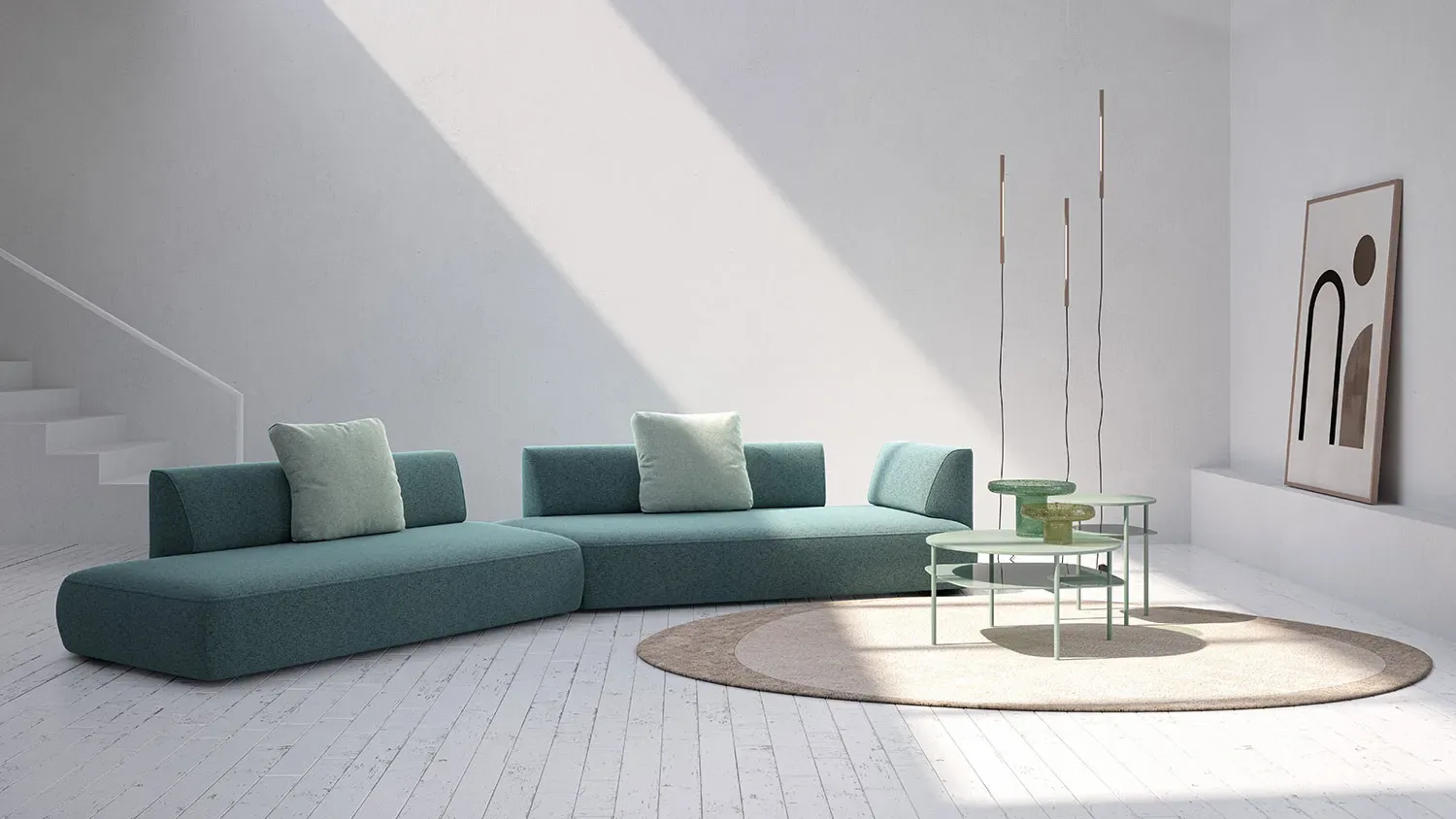
A completely free composition risks losing its centre. It is often useful to identify a main element that remains in position: a linear sofa, a larger module or a rug defining the area. Chairs, ottomans, backless seats and tables can be repositioned around this base.
The stable element provides orientation and preserves the identity of the living room after each change. Mobile parts add places, bring people closer or open circulation. This distinction simplifies actions and prevents every new arrangement from requiring the entire room to be reconsidered.
In modular systems, several elements may remain connected as the core while others stay independent. Connectors should be secure, accessible and easy to operate. If tools or complex actions are required, theoretical flexibility will probably be used infrequently.
Weight, dimensions and manageability
A mobile seat must be repositioned without excessive effort or damage to the floor. Weight needs to be considered together with grip: a light element without accessible holding points may still be awkward to lift. Bases, feet or glides must suit parquet, stone, ceramic flooring or rugs.
Dimensions matter as much as weight. A compact ottoman passes easily through gaps, while a deep module needs turning space and a free destination. Before purchase, full-size outlines can simulate the operation and reveal conflicts with doors, tables and other furniture.
The frequency of change suggests the appropriate solution. Elements repositioned every day need to be especially manageable. Modules intended for seasonal changes may be more substantial, provided connections are reversible and construction tolerates repeated handling.
Creating legible configurations
Reconfigurability should not produce a random collection. Seat heights, proportions and formal language need to create continuity even when elements are separated. Coordinated upholstery strengthens unity, while controlled differences in colour or texture can distinguish specific functions.
A conversational layout works when people can see one another without excessively rotating their bodies. Seats should not be so far apart that voices need to be raised or so close that movement is restricted. An ottoman can temporarily complete the circle, while a swivel chair makes it easy to alternate between conversation and viewing.
For relaxation, elements may align to create a larger surface. Levels should match and junctions should not feel uncomfortable. If an ottoman acts as an extension, its cushioning should provide support compatible with the main seat.
Circulation and alternative positions
Every mobile element needs an alternative location. Without a planned destination, a change frees one area only to obstruct another. A side wall, the back of the sofa or a well-lit corner can temporarily accommodate a seat, provided it remains useful and does not appear abandoned.
Main routes should remain recognisable in every configuration. Access to doors, windows and balconies must be checked, as should circulation between kitchen, dining and living zones. Occasional arrangements may accept greater density, but should not compromise safety or ease of use.
Cables also limit mobility. Lamps, devices and charging tables need to be planned so that wires do not cross walkways. Distributed sockets and adjustable lighting support more arrangements than services built around one fixed position.
Flexible tables and accessories
Reconfigurable seating requires equally adaptable surfaces. Lightweight, nesting tables or pieces at different heights can approach occupied places and clear the centre when required. One very large table may constrain the entire composition.
Rigid trays turn an ottoman into a temporary surface and increase its functions without adding permanent furniture. They should be stable and correctly proportioned. When not in use, they need an accessible storage position.
Adjustable floor lamps and suitable portable fittings follow variations more easily. General illumination should still provide an even foundation so that each configuration does not depend on numerous interventions.
The role of the rug
The rug creates a visual frame but should not obstruct repositioning. A surface large enough for the principal arrangements keeps the area unified. Very thick rugs may obstruct small feet or make modules unstable.
A rectangular form provides a clear base; an organic design can accompany freer compositions. In both cases, edges and weave need to suit circulation. An element repositioned frequently should not catch or require the rug to be lifted.
Colour can unify different upholstery or introduce a neutral field. It is preferable for the main variation to remain in the seating rather than adding an overly competitive floor pattern.
Consistent comfort in different positions
Mobility must not sacrifice ergonomics. A backless seat is useful as an additional place for limited periods but does not replace full support during prolonged use. The composition should offer a range of postures, including supported, informal and extended positions.
When independent modules are joined, they should not separate during use. Anti-slip connections or dedicated fasteners improve stability and safety. Contact points must not create hard gaps or noticeable differences in height.
Loose cushions can adjust depth and support, but need somewhere to go when not in use. Nearby storage or a controlled number of accessories prevents accumulation. True flexibility reduces the complexity of actions.
Materials and maintenance
Frequently repositioned elements receive contact on several sides. Upholstery must therefore be durable and well finished at the rear as well as the front. Seams, corners and bases deserve attention because they are stressed during handling.
Removable covers simplify maintenance and allow work on individual modules. Identical fabrics may nevertheless age differently when some elements receive more use or daylight than others. Periodically rotating seats helps distribute wear and colour variation.
For ordinary care, follow the instructions, vacuum with gentle attachments and treat marks quickly. Feet and glides should be checked because dust or small debris can scratch the floor during changes of position.
Everyday order
A flexible composition should return rapidly to its principal arrangement. If tidying requires many actions, elements will often remain in arbitrary positions. The design should define a habitual place for every seat, table and accessory.
Nearby storage can hold throws, trays and cushions. Avoiding an excess of small parts reduces visual maintenance. Flexibility works best when it comes from a limited number of components capable of several functions.
The household should also understand the logic of the arrangements. Intuitive solutions require no instructions and make adapting the living room to activities more natural.
Longevity and the sustainability of modularity
A reconfigurable system is durable when it can adapt to real changes: a different home, new habits or an evolving household. The ability to separate modules, replace upholstery or add an element reduces the need to change all the furniture.
Component availability and connector quality should be verified. Modularity based on fragile parts or finishes likely to disappear quickly has limited value. Repairable frames, replaceable cushioning and clear maintenance information contribute to useful life.
Sustainability does not depend on the number of promised configurations but on the system’s ability to remain relevant. A simple solution used frequently and retained for a long time is more effective than a complex one whose functions remain untouched.
Mistakes to avoid
The first mistake is purchasing numerous small elements without defining a main composition. The result may look fragmented and offer less comfort than a more restrained system. Another error is ignoring the space needed to relocate modules when they are not in use.
It is risky to rely on colour alone for unity. Coordinated elements should share proportions, heights and construction quality. Conversely, everything need not be identical: a considered difference can make functions recognisable.
Finally, a home should not require a lengthy procedure whenever the activity changes. If transformation is tiring, it will remain theoretical. The best solutions are intuitive, require few actions and restore order just as easily.
A system serving people
A dynamic living room does not abandon elegance in pursuit of transformation. It uses flexibility to keep the space proportionate to its people and activities. Every element needs a function, a position and a clear logic of use.
When stable core, mobile parts, routes and accessories are designed together, reconfigurability becomes a discreet and lasting quality. It is present when needed and almost invisible when the room returns to its everyday arrangement.