Fixed or extendable table: differences, advantages and limits
A guide to choosing between a fixed and an extendable table: differences, advantages, limits, materials, opening systems and the space needed to identify the solution best suited to your living area and your needs.
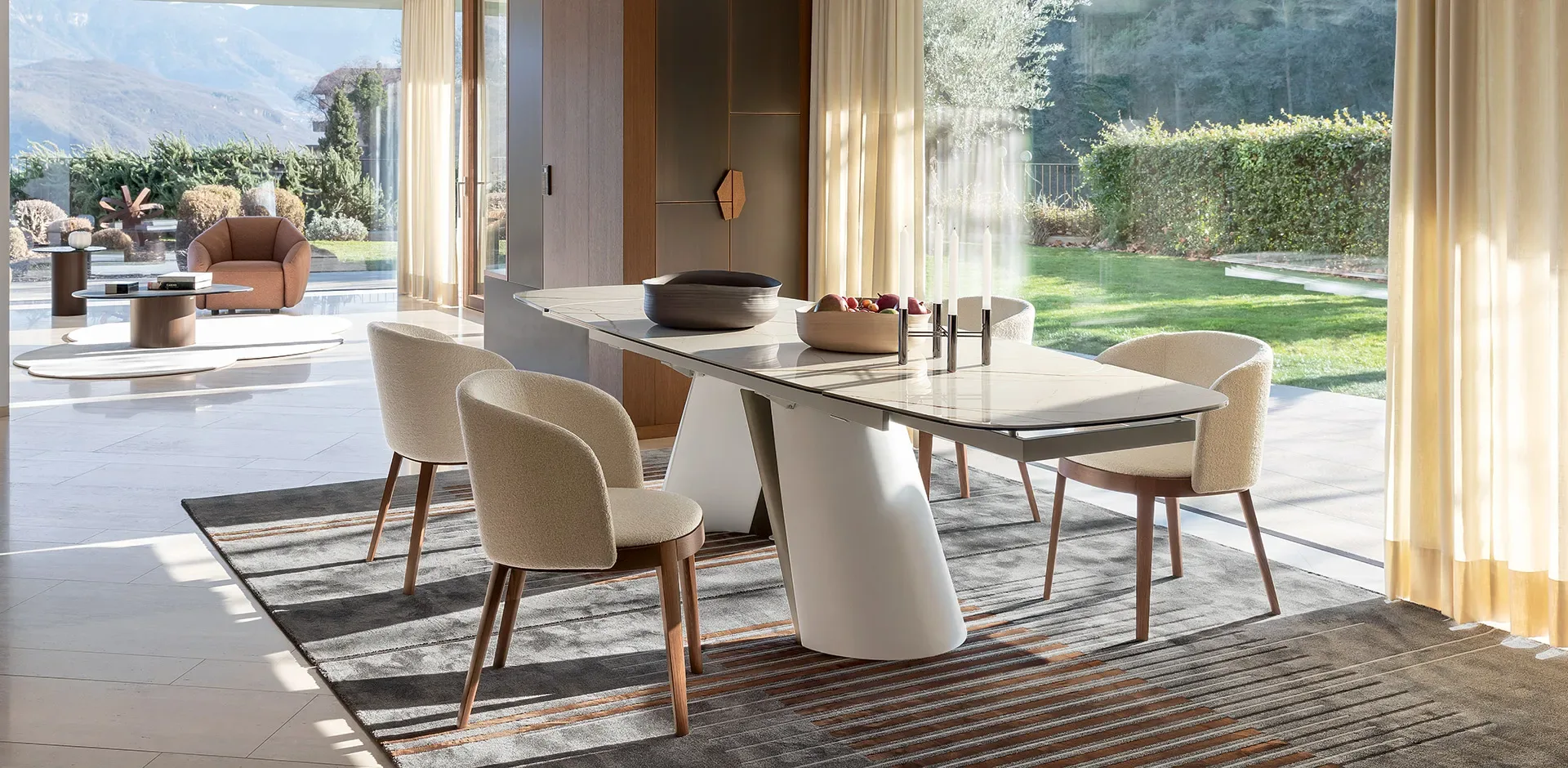
The table is one of the most important elements of the living area. It is not just a surface to rest things on, but a true meeting point that:
- defines the organisation of the space;
- influences movement paths;
- contributes to the aesthetic balance of the room.
The choice between a fixed table and an extendable table depends on several factors:
- the size of the room;
- the usual number of people;
- how often you have guests;
- the layout of the other furniture;
- your lifestyle.
There is no single best solution in absolute terms. There is the table most consistent with the design of the home.
Understanding the differences between the two types makes it possible to avoid oversized purchases, mechanisms that are rarely used, or solutions that are aesthetically pleasing but unsuited to everyday use.
What is the difference between a fixed and an extendable table
The fixed table always keeps the same dimensions. The structure, top and base are designed as a stable whole, without moving elements intended to increase the available surface.
The extendable table, on the other hand, incorporates an opening system that allows the length of the top to be changed. Depending on the model and the construction technology, the extensions can be:
- internal;
- pull-out;
- folding;
- separate.
The main difference therefore concerns flexibility:
- the fixed table offers a constant configuration;
- the extendable table adapts to different needs.
This distinction, however, also involves other aspects, such as:
- formal cleanliness;
- stability;
- weight;
- practicality;
- maintenance;
- space management.
Fixed table: essentiality and design continuity
The main advantage of a fixed table is the simplicity of the structure. The absence of opening mechanisms generally allows greater freedom in designing the top and the base.
The lines can be purer, the proportions more balanced and the thickness of the top more uniform. This aspect is particularly important in minimally designed tables, where every construction detail remains visible and contributes to the overall quality of the object.
Materials such as:
- marble;
- ceramic;
- glass;
- solid wood;
- textured surfaces;
can be enhanced with greater continuity, without interruptions due to the joints of the extensions.
The advantages of the fixed table
A fixed table usually offers a perception of greater solidity. This does not mean that a quality extendable model is unstable, but a structure without moving parts is by its nature simpler and more direct.
Among the main advantages are:
- a uniform look of the top;
- continuity of grain, texture and surface patterns;
- no opening operations;
- immediate availability in the final configuration;
- fewer components subject to wear.
The top keeps a homogeneous aesthetic, a feature that is particularly appreciable when the material is the main decorative element of the table.
The overall lifespan, however, always depends on the quality:
- of the materials;
- of the workmanship;
- of the structure;
- of the assembly.
The limits of the fixed table
The most obvious limit is the lack of flexibility. If the table is sized for four or six people, it cannot easily be adapted when the number of guests increases.
Choosing a very large model to compensate for this rigidity is not always a good solution. An oversized table:
- takes up space even when it is not needed;
- can obstruct movement paths;
- alters the proportions of the room;
- reduces freedom of movement.
The fixed table is therefore particularly suitable when:
- the number of users is fairly constant;
- the dining area is large;
- a second space is available for convivial occasions;
- the aesthetic continuity of the top is a priority.
Extendable table: flexibility and dynamic space management
The extendable table is designed to respond to variable needs. In the closed configuration it takes up a limited surface, while when needed it allows extra seats to be added.
It is an effective solution in contemporary settings, where living room, kitchen and dining area often share the same space.
The ability to change its dimensions makes it possible to:
- preserve good freedom of movement in daily life;
- keep proportions suited to the room;
- increase capacity only when necessary.
The quality of an extendable table depends significantly on the opening system.
A well-designed mechanism must be:
- intuitive;
- smooth;
- hard-wearing;
- stable;
- ideally usable by a single person.
The advantages of the extendable table
The main advantage is adaptability. A compact table can accommodate the family in daily life and transform when guests arrive.
This feature allows space to be used more efficiently. Instead of permanently occupying the room with a very long top, you keep a configuration proportionate to your usual needs.
The more advanced models can offer:
- extensions integrated into the structure;
- hidden guides;
- synchronised movements;
- quick opening;
- visual continuity between top and extensions;
- a reduced need for manual intervention.
When the extensions are integrated, there is no need to find a separate place to store them.
The limits of the extendable table
The presence of a mechanism makes the design more complex. Guides, hinges, supports and extensions must be made with precision to maintain over time:
- alignment;
- stability;
- smoothness of movement;
- correct load distribution.
In lower-quality models the following may appear:
- play between the parts;
- difficulty sliding;
- small differences in level;
- flexing of the top;
- premature wear of the components.
The joints also remain visible, especially with materials characterised by marked grain or continuous patterns.
In some cases, the extensions may have a slightly different finish from the main top, both for technical reasons and because of the different ageing of the surfaces.
A further limit concerns the space taken up in the open configuration.
Knowing that a table can reach a certain length does not mean that the room is actually able to accommodate it.
You also need to consider:
- the space taken up by the chairs;
- the distance needed to pull them back;
- the surrounding walkways;
- the position of walls, sideboards and other furniture.
How much space is needed around the table
Assessing the space taken up is crucial for both types.
Between the edge of the table and a wall, a sideboard or another fixed element, it is advisable to leave:
- 75-80 centimetres as a minimum distance;
- 90-100 centimetres for more comfortable use.
In the case of an extendable table, these measurements must be checked in the fully open configuration, not only when the table is closed.
You should also check the position of the legs or the base:
- some perimeter structures limit the arrangement of the seats;
- a central base often offers greater freedom;
- the position of the supports can change during opening;
- the extensions can create new support points.
The shape of the top
The shape also affects the perception and management of space:
- the rectangular table follows the longitudinal development of the room well;
- the round table makes communication between diners easier;
- the oval table aids circulation;
- shapes without corners are more practical in narrow passages.
Opening systems: which differences to consider
Not all extendable tables work in the same way.
Internal extensions
In systems with internal extensions, the extensions are held under the top.
This solution is practical because:
- all the elements remain integrated;
- no separate space is needed to store them;
- the table can be opened more quickly.
Telescopic mechanisms
Telescopic mechanisms allow one or both ends to slide, creating the space needed to insert or raise the extensions.
Synchronised systems
In synchronised systems, moving one side also activates the opposite one, making opening simpler and more even.
Separate extensions
There are also tables with separate extensions. This configuration can ensure greater aesthetic continuity in the closed version, but requires adequate space to store the additional elements.
Before choosing, it is useful to actually try the mechanism and check that:
- the opening is smooth;
- the top does not flex;
- the extensions stay aligned;
- the locking system is stable;
- the operation can be carried out without excessive effort.
Materials and finishes: what changes
In the fixed table the material can express itself without interruptions. A ceramic slab, a marble top or a wooden surface with continuous grain gain greater visual strength.
In the extendable table, on the other hand, you have to consider the presence of the divisions.
Uniform surfaces or those with regular textures tend to mask the joints better, while very evident grain can make them more noticeable.
Ceramic
Ceramic offers:
- good scratch resistance;
- heat resistance;
- reduced stain absorption;
- ease of cleaning.
It does, however, require precise workmanship at the joining points.
Wood
Wood conveys warmth and naturalness, but can show:
- colour variations;
- differences between top and extensions;
- changes due to light;
- natural movements of the material.
Glass
Glass visually lightens the structure, but makes the following more evident:
- fingerprints;
- dust;
- mechanical components;
- joints;
- support elements.
Laminates and technical surfaces
Advanced laminates and technical surfaces ensure:
- ease of maintenance;
- good resistance;
- a variety of colours and finishes;
- greater uniformity between top and extensions.
The choice should therefore not be based only on the initial appearance. It is important to assess:
- everyday use;
- frequency of opening;
- sensitivity of the material;
- ease of cleaning;
- how the surface ages.
Stability and durability over time
A well-built fixed table has a relatively simple structure, with few elements subject to movement. This can favour a long lifespan and reduce the need for adjustments.
In an extendable table, on the other hand, the quality of the mechanism is crucial.
The following must be suited to the weight of the top and the frequency of use:
- metal guides;
- supports;
- fixing points;
- locking systems;
- hinges;
- sliding elements.
To keep it working, it is advisable to:
- keep the guides clean;
- avoid forced movements;
- follow the manufacturer's instructions;
- not apply lateral pressure;
- not place improper loads on the extensions;
- periodically check the tightness of the structure.
Assembly also affects stability. A top that is not perfectly level or a structure assembled imprecisely can compromise operation, especially in large models.
Which table to choose according to your needs
When to choose a fixed table
The fixed table is generally suitable for those who:
- have a well-defined space;
- always use a similar number of seats;
- place particular importance on the continuity of the top;
- want a simple structure;
- prefer natural materials or continuous grain;
- want to turn the table into a sculptural element.
It is a consistent choice when the table takes on a central role in the room thanks to:
- an important base;
- a natural material;
- an essential geometry;
- artisanal workmanship;
- a surface of strong visual impact.
When to choose an extendable table
The extendable table is suitable when:
- the space has to serve different functions;
- the living area is open-plan;
- the kitchen is eat-in;
- you have guests fairly often;
- the number of diners varies;
- it is important to keep more free space in daily life.
The choice, however, must start from real use.
Buying an extendable table for a very rare eventuality may mean accepting greater complexity without a real benefit.
Likewise, choosing a fixed table that is too small can make the more frequent convivial occasions uncomfortable.
The mistakes to avoid
Assessing only the theoretical number of seats
The figures given for each model often represent a maximum capacity, but do not always correspond to genuinely comfortable seating.
You need to consider:
- the width available for each person;
- the position of the table legs;
- the size of the chairs;
- the presence of armrests;
- the distance between one seat and the next.
Not simulating the space taken up
Measuring the table without simulating its presence in the room can lead to an incorrect assessment.
It is useful to mark the perimeter of the top on the floor:
- in the closed configuration;
- in the open configuration;
- with the chairs in position;
- with the space needed to pull the seats back.
Not trying the opening system
It is unwise to choose an extendable table without trying the mechanism.
The system must be compatible with:
- the user's physical strength;
- the frequency of opening;
- the space available;
- how the extensions are stored;
- daily habits.
Neglecting the lighting
A pendant lamp centred on the closed table might end up off-centre when the top is extended.
In more flexible projects you can consider:
- linear compositions;
- adjustable systems;
- electrified tracks;
- multiple light points;
- lamps that can be moved off-centre;
- diffused lighting systems.
Fixed or extendable table: a design choice
The decision between a fixed and an extendable table is not only about the number of available seats. It involves the way the space is lived in every day.
The fixed table favours:
- stability;
- formal purity;
- continuity of materials;
- structural simplicity.
The extendable table offers:
- adaptability;
- dynamic space management;
- greater occasional capacity;
- flexibility in everyday use.
The most correct choice arises from the balance between dimensions, functionality, build quality and aesthetics.
Before deciding, it is useful to:
- observe your own habits;
- measure the space precisely;
- simulate the space taken up;
- try the opening system;
- consider the table as part of the overall project.
A well-proportioned table, consistent with the room and suited to real use, keeps its value over time, both functionally and aesthetically.
Updated on